Magnolia Teddy Bear: Size, Care, Problems & Comparison
Few evergreen trees pack as much charm into a compact frame as the Magnolia Teddy Bear. If you’re sizing one up for a yard that’s more suburban than estate, you’ll want the full picture — mature height, common problems, and how it really compares to the popular Little Gem. Here, grounded in nursery data and horticultural guidance, is what you need to know before planting.
Mature Height: 15–20 ft (4.5–6 m) ·
Mature Spread: 8–12 ft (2.4–3.6 m) ·
USDA Zone: 7–9 ·
Bloom Time: Late spring to summer ·
Sun: Full sun to partial shade ·
Foliage: Evergreen, glossy with brown felt undersides
Quick snapshot
- Mature height 15–20 ft, spread 8–12 ft (Monrovia, premium U.S. nursery)
- Hardy in USDA zones 7–9 (LSU AgCenter, Louisiana extension service)
- Evergreen with brown felt on leaf undersides (Monrovia)
- Exact longevity for this cultivar — likely 50+ years but not extensively documented (LSU AgCenter)
- Response to coffee grounds varies by soil type — limited studies (Gardenia.net, plant reference database)
- Blooms late spring through summer, with sporadic repeat blooms (LSU AgCenter)
- Average growth rate 6–12 inches per year under optimal conditions (Monrovia)
- Plant in well-drained, acidic soil and water deeply during establishment (Nursery Near Me, Australian tree specialists)
- Prune in late winter before new growth (Nursery Near Me)
Here are the key specifications in a glance.
| Attribute | Value |
|---|---|
| Botanical Name | Magnolia grandiflora ‘Teddy Bear’ |
| Common Name | Teddy Bear Magnolia, Teddy Bear Southern Magnolia |
| Plant Type | Evergreen tree (cultivar) |
| Mature Height | 15–20 feet (4.5–6 m) |
| Mature Spread | 8–12 feet (2.4–3.6 m) |
| USDA Hardiness Zones | 7–9 |
| Bloom Color | White, lemon-fragrant |
| Bloom Season | Late spring to summer |
| Sun Exposure | Full sun to partial shade |
| Soil pH | Acidic to slightly acidic (5.5–6.5) |
How Big Does a Teddy Bear Magnolia Grow?
Mature height and spread
- According to Monrovia, premium U.S. nursery, the Teddy Bear reaches 15–20 feet tall with a spread of 8–12 feet. Platypus Plants, Australian nursery specialists reports 4–6 metres high and 2–3 metres wide, while Leafy Heaven, horticultural blog cites 3–4 metres. The variation reflects regional growing conditions, but the consensus is a compact tree suitable for small spaces.
Six feet at maturity, twelve feet wide — numbers that fit comfortably in a typical front garden without overwhelming the house. That’s the whole point of the cultivar.
Growth rate per year
- Under optimal conditions — full sun, rich acidic soil, consistent moisture — the Teddy Bear adds 6 to 12 inches per year (Monrovia).
The implication: you won’t get instant shade, but you also won’t have to prune every season to keep it in bounds.
Container vs in-ground size
- In a large container, height is often limited to 8–10 feet with regular root pruning. In-ground trees reach the full 15–20 feet range (Nursery Near Me, Australian tree specialists).
Why this matters: container growing gives you flexibility but demands more watering and periodic root management.
Teddy Bear’s compact habit means you can plant it where a standard southern magnolia would crowd the eaves. Homeowners in Zone 7–9 with limited lot space get the iconic magnolia look without the 60-foot canopy.
The takeaway: choose the right planting location to maximize growth and avoid future transplanting.
What Are Common Problems with Teddy Bear Magnolias?
Leaf spot and fungal diseases
- Anthracnose, sooty mold, and leaf spot are the most frequent fungal issues, especially in humid climates (LSU AgCenter, Louisiana extension service). Good air circulation and avoiding overhead watering reduce risk.
A single season of wet foliage can trigger sooty mold, which feeds on honeydew from scale insects — a double problem.
Scale insects and aphids
- Magnolia scale and aphids are common pests. Scale appears as small bumps on stems and leaves; both pests excrete honeydew that leads to black sooty mold (LSU AgCenter).
Treatment: horticultural oil or insecticidal soap applied in early spring before new growth hardens off (Nursery Near Me).
Nutrient deficiencies
- Yellowing leaves (chlorosis) often signal iron deficiency, common in alkaline soils. Teddy Bear prefers a pH of 5.0–6.5 (Nursery Near Me). Adding chelated iron or soil sulfur can correct it.
The trade-off: if your soil is naturally alkaline, you’ll need to amend it annually or choose a different tree.
Environmental stress (cold, drought)
- Teddy Bear is hardy to Zone 7, but young trees may suffer leaf burn in a hard freeze. Once established, moderate drought tolerance — but regular watering during dry spells keeps foliage pristine (Monrovia).
What this means: in the upper end of its zone (Zone 7), protect young trees with mulch and an occasional frost blanket.
Most problems stem from poor drainage or alkaline soil. Fix those two variables, and Teddy Bear is remarkably low-maintenance. Ignore them, and you’ll be treating leaf spot every summer.
The implication: proper site preparation prevents the vast majority of health issues.
How to Treat a Struggling Teddy Bear Magnolia
- Diagnose the problem by checking leaf color, soil moisture, and visible pests.
- Adjust watering and drainage — deep, regular water during establishment, then let top inch dry.
- Fertilize with balanced slow-release fertilizer in early spring; use coffee grounds sparingly to acidify soil.
- Control pests with horticultural oil or insecticidal soap applied at the right season.
Diagnosing the problem
- Start with visual clues: yellow leaves (chlorosis), black soot (scale), brown leaf edges (overwatering or salt stress). Check soil moisture by sticking a finger 2 inches deep (Nursery Near Me).
Don’t guess — the most common misdiagnosis is overwatering when the real issue is iron deficiency.
Adjusting watering and drainage
- Teddy Bear requires deep, regular watering during the first two growing seasons to establish a strong root system (Monrovia). After that, let the top inch of soil dry between waterings. Poor drainage is a leading cause of root rot.
If water pools after a rain, consider raising the planting bed or amending the soil with organic matter.
Fertilizing for recovery
- Use a balanced slow-release fertilizer (e.g., 10-10-10) in early spring, before new growth emerges. Over-fertilizing can burn roots — follow product rates (Nursery Near Me).
- Coffee grounds can acidify soil and add nitrogen, but use sparingly — a 1-cm layer worked into the top soil once a season is enough (Gardenia.net, plant reference database).
Pest control methods
- For scale and aphids, apply horticultural oil during the dormant season or insecticidal soap when insects are active. Neem oil is also effective (LSU AgCenter).
- Remove severely infested branches and dispose of them away from the tree.
The pattern: catch pests early — a small scale outbreak can be wiped out with a single spring oil spray, while a full infestation may need repeated treatments.
Which Is Better: Magnolia Little Gem or Teddy Bear?
Three dimensions separate these two compact southern magnolias: size, leaf character, and bloom display. Here’s how they stack up head-to-head.
| Attribute | Little Gem | Teddy Bear |
|---|---|---|
| Mature height | 15–20 ft (4–6 m) (Evergreen Trees Australia, tree nursery) | 15–20 ft (4.5–6 m) (Monrovia) |
| Mature spread | 8–10 ft (2.4–3 m) (Platypus Plants) | 8–12 ft (2.4–3.6 m) (Platypus Plants) |
| Growth habit | Slender, columnar (Platypus Plants) | Compact, upright, rounded (Platypus Plants) |
| Leaf undersides | Light brown fuzz (Leafy Heaven) | Heavy brown felt (Leafy Heaven) |
| Flower size | 10–15 cm (Platypus Plants) | 15–20 cm (Platypus Plants) |
| Bloom period | March–April, longer bloom window (Evergreen Trees Australia) | Late spring to summer, sporadic repeats (LSU AgCenter) |
| Disease resistance | Moderate (Evergreen Trees Australia) | Generally more resistant (Evergreen Trees Australia) |
The pattern: choose Little Gem if you want a taller, narrower silhouette and a longer bloom season. Choose Teddy Bear if you prefer a denser, more rounded tree with larger, fuzzier leaves and better disease resistance.
Is Magnolia Teddy Bear Sun or Shade?
Optimal sun exposure for growth
- Full sun (6+ hours of direct sunlight per day) produces the densest foliage and the heaviest flowering (LSU AgCenter).
In practice, that means a south- or west-facing spot without overhead shade from larger trees.
Tolerances and pitfalls
- Partial shade (filtered light or morning sun) is tolerated, but the tree may become leggy and bloom less. In very hot climates (Zone 9), afternoon shade can prevent leaf scorch (Nursery Near Me).
The catch: too much shade and you lose the compact form that makes Teddy Bear desirable.
Regional considerations
- In the humid Southeast (USDA 7–8), full sun is ideal. In the drier Southwest (Zone 9), light afternoon shade reduces water stress (Monrovia).
Why this matters: the same tree can behave differently from Atlanta to Phoenix. Match the sun exposure to your microclimate.
Lifespan and Bloom Time of Teddy Bear Magnolia
Expected lifespan
- With proper care, Teddy Bear typically lives 50–80 years — in line with other Magnolia grandiflora cultivars (LSU AgCenter).
That’s long enough to shade two generations of gardeners.
Flowering season and frequency
- Blooms appear from late spring through summer, with sporadic repeat blooms possible into early autumn. Each flower lasts 2–3 days (LSU AgCenter).
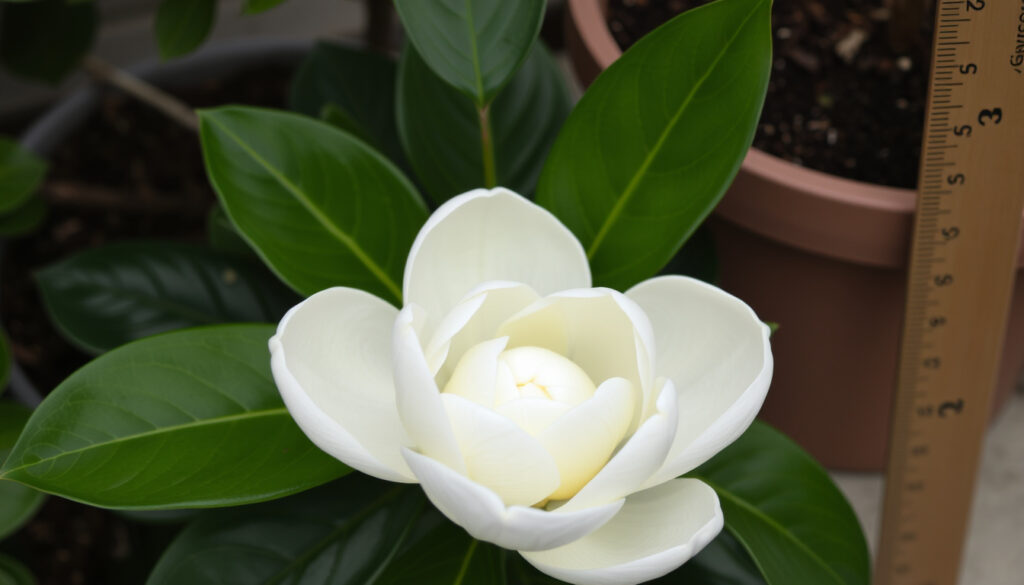
- Flowers are cup-shaped, up to 20 cm across, and strongly lemon-scented (Platypus Plants).
What to watch: first blooms may not appear until the tree is 2–3 years old and well-established.
When to expect first blooms
- Container-grown trees purchased from a nursery may bloom in the first year after planting, but most homeowners see the first flowers in year two or three (Nursery Near Me).
The trade-off: patience is rewarded with larger flowers as the tree matures.
For a tree that lives half a century or more, the first two years of careful watering and soil management are a tiny investment for decades of low-maintenance evergreen structure and fragrant summer blooms.
The takeaway: invest in early care for a long-lasting ornamental tree.
Confirmed facts
- Mature height and spread as per Monrovia and LSU AgCenter
- USDA zones 7–9 hardiness
What’s unclear
- Exact longevity (likely 50+ years but not extensively documented for this cultivar)
- Response to coffee grounds in different soil types (limited studies)
“The Teddy Bear magnolia is cute, compact and classic — ideal for small spaces where a full-size southern magnolia won’t fit.”
LSU AgCenter (Louisiana agricultural extension)
“‘Teddy Bear’ features an upright, dense habit with glossy leaves that are a rich green above and brown-felted beneath.”
Monrovia (premium U.S. nursery)
For homeowners with limited yard space, the choice is clear: the Teddy Bear offers a manageable evergreen alternative without sacrificing the iconic magnolia bloom. Plant it in full sun with acidic, well-drained soil, water deeply during establishment, and you’ll have a low-maintenance specimen that earns its keep for decades. The alternative — a standard southern magnolia — can easily outgrow a suburban lot within fifteen years. Teddy Bear won’t.
For those considering this compact evergreen for a tight garden corner, our detailed growth and care guide offers practical advice on watering, pruning, and spacing.
Frequently asked questions
How often should I water a Teddy Bear magnolia?
During the first two growing seasons, water deeply once or twice a week — more often in summer, less in winter (Nursery Near Me). Once established, water when the top inch of soil feels dry.
What are the best companion plants for Teddy Bear magnolia?
Evergreen ferns, hostas, azaleas, and camellias thrive in the dappled shade beneath its canopy. Avoid plants that need alkaline soil (Gardenia.net, plant reference database).
Can Teddy Bear magnolia be grown in a container?
Yes, but choose a large container (at least 24 inches wide) and use acidic potting mix. Container-grown trees stay smaller and need more frequent watering (Nursery Near Me).
Is Teddy Bear magnolia drought tolerant after establishment?
Moderately. After 2–3 years, it can handle brief dry spells, but prolonged drought leads to leaf drop and reduced flowering (Monrovia).
When is the best time to fertilize Teddy Bear magnolia?
Early spring, just before new growth breaks. Use a balanced slow-release fertilizer; avoid high-nitrogen formulas that promote soft, pest-prone growth (Nursery Near Me).
How do I prepare the soil for planting Teddy Bear magnolia?
Dig a hole twice as wide as the pot but no deeper. Mix in plenty of organic matter (compost or peat moss) to improve drainage and acidity. Ensure the top of the root ball sits slightly above ground level (LSU AgCenter).
What is the origin of the Teddy Bear magnolia cultivar?
The cultivar was developed by Monrovia as a compact, denser selection of Magnolia grandiflora specifically for residential landscapes (Monrovia).
You may also be interested in Raised Garden Beds and 12v Water Pump Buying Guide for related garden planning resources.
More related posts
 Skai Jackson’s Baby Father, Single Motherhood, and Health Rumors
 Harry Potter Series 2026: HBO Reboot Cast Books Release Date
 Moon Knight Season 2: Confirmed, Cancelled, or Coming
 Cast of Freakier Friday (2025): Full List and Stories
 Christopher Schwarzenegger: Bio, Weight Loss, Career & Family
 Aaron Eckhart: What Happened to His Career & Personal Life
 MacKenzie Scott: Bio, Net Worth, Philanthropy & Personal Life
 Insurance Quote Bingle – Get Yours in Under 5 Minutes
