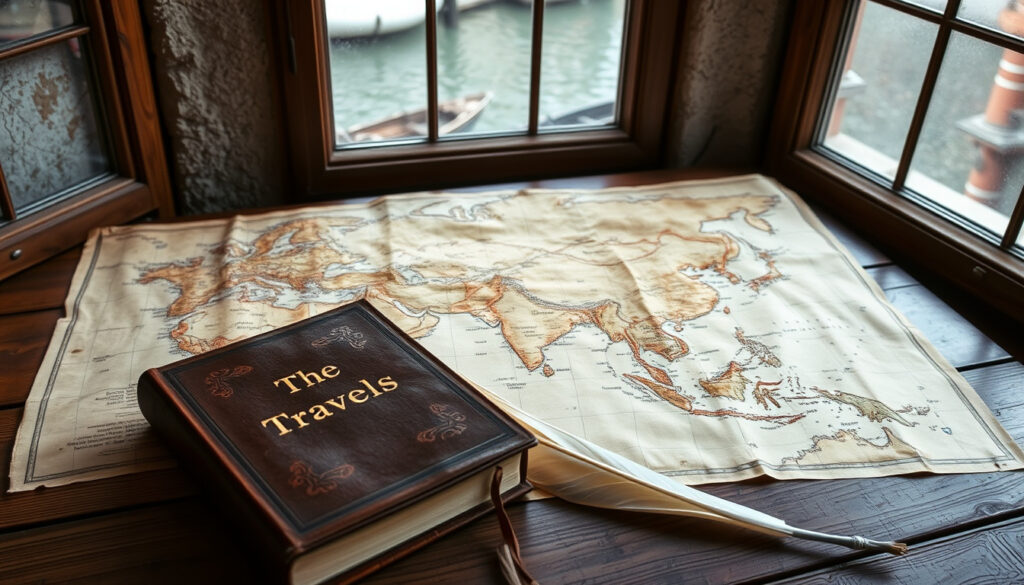
Marco Polo: The Venetian Explorer Behind ‘The Travels’
Few medieval travelers still spark as much debate as Marco Polo. The Venetian merchant’s journey along the Silk Road and his years at the court of Kublai Khan produced one of the most famous travel books ever written. But separating fact from legend in his story is no simple task. This article sifts through the evidence to find what we really know about the man behind the myths.
Born: 1254, Venice ·
Died: January 8, 1324, Venice ·
Travel period: 1271–1295 ·
Years in China: 17 ·
Key book: The Travels of Marco Polo ·
Imprisoned: 1298–1299 (Genoa)
Quick snapshot
- Venetian merchant who traveled the Silk Road (Britannica (encyclopedia))
- Served Kublai Khan for 17 years (World History Encyclopedia (historical reference))
- Dictated his book while imprisoned in Genoa (UCLA CMRS (medieval studies center))
- Whether Polo visited all places he described (e.g., Tibet, Japan) (Live Science (science news))
- Existence of a Chinese wife — no contemporary evidence (Britannica (encyclopedia))
- Exact wording of his deathbed statement (Wikipedia (user-edited encyclopedia))
- Born 1254 in Venice (Britannica)
- Departed 1271, returned 1295 (Britannica)
- Captured 1298, died 1324 (Britannica)
- Historians continue to debate the accuracy of The Travels (BBC Travel (travel journalism))
- New archaeological discoveries may shed light on Polo’s routes (World History Encyclopedia)
Seven key facts, one pattern: Marco Polo’s life is well-documented in broad strokes, but the finer details remain contested.
| Field | Value |
|---|---|
| Full Name | Marco Polo |
| Born | 1254, Venice (Republic of Venice) |
| Died | January 8, 1324, Venice |
| Nationality | Venetian |
| Occupation | Merchant, Explorer, Writer |
| Known For | Silk Road travels to China, service to Kublai Khan |
| Book | The Travels of Marco Polo (c. 1300) |
What was Marco Polo famous for?
Biography overview
Marco Polo was a Venetian merchant who traveled to Asia along the Silk Road between 1271 and 1295, as recorded by Britannica (encyclopedia). He spent about 17 years in China during the Yuan dynasty, serving under Kublai Khan (World History Encyclopedia (historical reference)).
Key accomplishments
- His book, The Travels of Marco Polo (also known as Il Milione), introduced Europeans to the Mongol Empire and Yuan China in unprecedented detail (Britannica).
- The account was dictated to fellow prisoner Rustichello da Pisa during Polo’s imprisonment in Genoa (UCLA CMRS (medieval studies center)).
- The work became a medieval bestseller, widely copied and translated (BBC Travel (travel journalism)).
Why he is remembered
Polo’s narrative helped shape European perceptions of Asia for centuries. Later explorers, including Christopher Columbus, reportedly carried a copy of The Travels (Live Science (science news)). The implication: Polo’s legacy rests not just on his travels, but on the book that turned those travels into a lasting cultural artifact.
Marco Polo is more famous for what he wrote than for what he did. His book gave medieval Europe its most detailed window into the East — and that window remained open for centuries.
The implication: Polo’s lasting fame is tied to his written account, not his deeds alone.
Did Genghis Khan know Marco Polo?
The timeline of Genghis Khan and Marco Polo
Genghis Khan died in 1227, decades before Marco Polo was born around 1254 (Britannica). The two never met. The confusion often arises because Polo served Kublai Khan, a grandson of Genghis Khan (World History Encyclopedia).
Had the Polo family encountered Genghis?
No evidence suggests the Polo family ever met Genghis Khan. Marco’s father, Niccolò, and uncle, Maffeo, traveled to the Mongol court and met Kublai Khan, not Genghis, during an earlier journey (BBC Travel). The catch: this common misconception stems from conflating the Mongol Empire’s founder with its most famous ruler.
Who was Kublai Khan?
Kublai Khan was the founder of the Yuan dynasty in China and a grandson of Genghis Khan. He reigned from 1214 to 1294 and employed Marco Polo as a trusted envoy (World History Encyclopedia).
What happened to Marco Polo in real life?
Travels to the Mongol Empire
Marco left Venice in 1271 at age 17, traveling with his father and uncle (Britannica). They followed the Silk Road through Central Asia, reaching Kublai Khan’s court in 1275 (World History Encyclopedia).
Service to Kublai Khan
Polo remained in China for 17 years, reportedly serving as a trusted envoy for the Khan (UCLA CMRS). The details of his missions are drawn largely from his own account.
Return to Venice
In 1292, Polo departed from China as part of an escort for a Mongol princess. He reached Venice in 1295 after an absence of 24 years (Britannica).
Personal life: marriage and descendants
After his return, Marco Polo married Donata Badoer in 1300, and the couple had three daughters (Britannica). The story of a Chinese wife is a later legend with no contemporary evidence.
Did Marco Polo have a Chinese wife?
No. The tale of a Chinese wife appears in later folklore, not in Polo’s own writings or any contemporary source (Live Science). The pattern: Polo’s personal life has been embellished over time, but the historical record is clear on his Venetian marriage.
Did Marco Polo marry anyone?
Yes, he married Donata Badoer in 1300, and they had three daughters. No records indicate any other marriages (Britannica).
Did Marco Polo fall in love?
There are no contemporary accounts of Polo falling in love. Stories of a romantic attachment in China are unsubstantiated legends.
How long did Marco Polo’s journey take?
The entire journey from Venice to China and back lasted 24 years, from 1271 to 1295 (Britannica).
Bottom line: Marco Polo’s 24-year journey and 17-year service under Kublai Khan are well-documented, but personal and romantic details remain largely speculation.
Why was Marco Polo jailed?
Capture in 1298
Polo was captured during a naval battle between Venice and Genoa, likely the Battle of Curzola (Britannica). He was imprisoned in Genoa for about a year.
Imprisonment and dictation of his book
While in prison, Polo dictated his travel stories to a fellow inmate, Rustichello da Pisa, a writer of romances (UCLA CMRS). The resulting manuscript became The Travels of Marco Polo.
Release and later life
Polo was released in 1299 and returned to Venice, where he lived until his death in 1324 (Britannica). The trade-off: his imprisonment gave the world one of the most influential travel narratives ever written.
Polo’s book made him famous, but it’s the gaps in his account that keep historians arguing. His imprisonment was the crucible that turned experience into legend.
The paradox: imprisonment gave the world one of the most influential travel narratives.
What did Marco Polo say before he died?
Last words according to accounts
A popular tradition, first recorded by the Venetian scholar Giovanni Battista Ramusio in 1559, claims Polo said on his deathbed: “I have not told half of what I saw.” The authenticity is debated, and no contemporary source confirms it (Wikipedia (user-edited encyclopedia)).
“I have not told half of what I saw.”
— Giovanni Battista Ramusio, 16th-century scholar (Wikipedia)
“The palace is the largest palace that ever was seen.”
— Marco Polo, from The Travels, describing Kublai Khan’s palace (World History Encyclopedia)
Debates about the authenticity of his tales
Some later traditions give Polo a specific birth date of September 15, 1254, but this is not universally accepted (Wikipedia). The uncertainty extends to his death date: some sources list January 9, 1324 instead of January 8 (Wikipedia).
Descendants and family legacy
Marco Polo’s three daughters — Fantina, Bellela, and Moreta — carried on the family line, and living descendants exist in Venice and elsewhere (Live Science).
Are there any living descendants of Marco Polo?
Yes, living descendants have been identified in Venice and other locations, though the line is not widely documented (Live Science).
What is the legacy of Marco Polo?
Polo’s book inspired later explorers, most notably Christopher Columbus, and continues to inform historical understanding of medieval Asia. His legacy is one of cultural exchange and enduring mystery.
The implication: the most famous quote attributed to Polo is likely apocryphal, but it perfectly captures the mixture of wonder and skepticism that still surrounds his legacy.
Bottom line: Marco Polo’s deathbed statement is unverified, but his book’s influence on European exploration and historical scholarship is undeniable.
Timeline of Marco Polo’s Life
Eight milestones, one arc: from Venetian merchant to legendary author.
| Date | Event |
|---|---|
| 1254 | Marco Polo born in Venice (Britannica) |
| 1271 | Departs with father Niccolò and uncle Maffeo for Asia (Britannica) |
| 1275 | Arrives at Kublai Khan’s court (World History Encyclopedia) |
| 1292 | Departs from China as part of escort for Mongol princess (Britannica) |
| 1295 | Returns to Venice after 24 years (Britannica) |
| 1298 | Captured by Genoese in battle; imprisoned in Genoa (Britannica) |
| 1299 | Dictates The Travels of Marco Polo to Rustichello da Pisa (UCLA CMRS) |
| 1324 | Dies in Venice; buried in San Lorenzo church (Britannica) |
What this means: each milestone solidifies the journey from merchant to myth.
Confirmed facts
- Marco Polo traveled to Asia and served Kublai Khan (Britannica)
- He wrote a book about his travels (Britannica)
- He married Donata Badoer and had three daughters (Britannica)
- He was imprisoned in Genoa and dictated his account (UCLA CMRS)
What’s unclear
- Whether he personally visited all places described in his book (e.g., Tibet, Japan) (Live Science)
- The existence of a Chinese wife (no contemporary evidence) (Britannica)
- The exact wording of his deathbed statement (Wikipedia)
- The total number of children (some sources mention three daughters, others two) (Live Science)
Key Quotes
“I have not told half of what I saw.”
— Giovanni Battista Ramusio, 16th-century scholar (Wikipedia)
“The palace is the largest palace that ever was seen.”
— Marco Polo, from The Travels, describing Kublai Khan’s palace (World History Encyclopedia)
For modern readers, the choice is clear: engage with Polo’s account as a remarkable window into the medieval world, but keep a skeptical eye on the legends that have grown around it. The man who said he hadn’t told half of what he saw may have been exaggerating — but his book remains one of the most influential ever written.
Learn more about Marco Polo in our companion article: Marco Polo: Biography, Travels, and Legacy. For other historical adventures, see: Mount Kilimanjaro: Difficulty, Safety & Beginner Guide.
history.com, simple.wikipedia.org, encyclopedia.com, es.wikipedia.org, study.com, heritage-history.com
The question of what Marco Polo actually witnessed remains contentious, but a guide to separating facts from myths provides a careful evaluation of the sources.
Frequently asked questions
Was Marco Polo the first European to reach China?
No. Merchants and missionaries from Europe had reached China before Polo, but his account was the most detailed and widely circulated (Britannica).
How did Marco Polo’s travels impact European exploration?
His book inspired later explorers, most notably Christopher Columbus, who carried a copy of The Travels on his voyages (Live Science).
Is the Netflix series ‘Marco Polo’ historically accurate?
The series dramatizes events and invents characters. While it captures the broad setting of Polo’s service to Kublai Khan, many details are fictionalized (BBC Travel).
Did Marco Polo learn Chinese or Mongolian languages?
Polo likely learned Mongolian and possibly some Chinese, but the extent of his language skills is not documented. He served as a diplomat for Kublai Khan, which suggests some proficiency (World History Encyclopedia).
What goods did Marco Polo bring back to Europe?
Polo’s account describes many goods from the East, including spices, silk, and precious stones. However, there is no contemporary list of what he personally brought back (Britannica).
How do historians verify the details of Polo’s travels?
Historians cross-reference Polo’s descriptions with Chinese, Persian, and Mongol records, as well as archaeological evidence. Many details remain unverifiable (Live Science).
What is the controversy about whether Polo really went to China?
Some scholars argue that Polo’s account lacks mention of practices like footbinding or the Great Wall, raising doubts about whether he traveled as far as he claimed. Others defend his narrative as accurate for a foreign observer (BBC Travel).
More related posts
 Woodside (ASX:WDS) Stock Analysis: Dividend, Ratings & Forecast
 Oliver Cromwell: What He Did, Controversies, and Legacy
 James Ransone Dead at 46: Cause of Death and Career
 Pantoprazole 20 mg – Uses, Dosage and Side Effects
 Sailor Moon: LGBTQ Themes, Cancellation, Streaming & Age Guide
 Time in New Zealand: Current Local Time and Time Zones
 Who Died Today? Latest Celebrity Deaths & Obituary Guide
