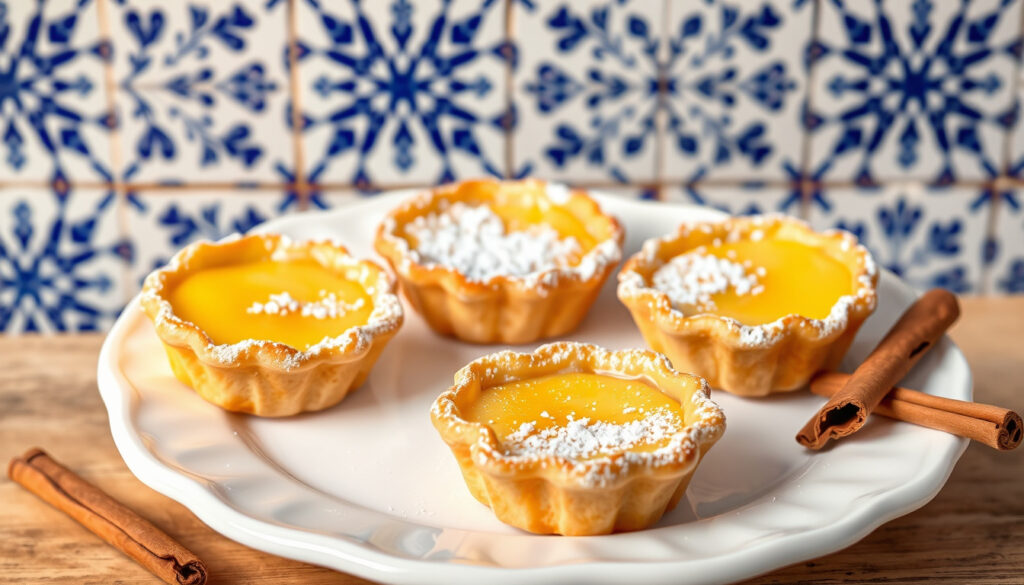
Pastel de Nata: Guide to Authentic Portuguese Custard Tarts
If you’ve ever stood outside a Lisbon bakery at 6 a.m., cup in hand, waiting for the door to open, you already know: pastel de nata isn’t just a tart. It’s a small, scorched miracle that turns a morning into a memory. This guide walks through what makes them work, where to find them near you, and how to make the real thing at home—even if your oven doesn’t hit 550°F.
Origin: Portugal · Literal Translation: cream pastry · Key Ingredients: egg custard and puff pastry · Iconic Location: Lisbon · Common Serving: warm with powdered sugar
Quick snapshot
- Egg custard base originated at Jerónimos Monastery in Belém (Trafalgar Tours)
- Recipe sold after monastery closed in 1834; Fábrica de Pastéis de Belém opened 1837 (Wikipedia)
- Authentic recipe uses puff pastry with cinnamon, lemon, vanilla custard (Great British Bake Off)
- Exact calorie variation between bakery brands vs homemade versions
- Precise ingredient ratios for original monastery recipe (still secret at Pastéis de Belém)
- Egg whites used for starching clothes; yolks for pastries from 1700s onward (Wikipedia)
- Liberal Revolution 1820 triggered monastery closures, prompting recipe sale (Wikipedia)
- UK supermarkets increasingly stock Portuguese tarts alongside English custard tarts (Great British Chefs)
- Home baking trend drives demand for authentic high-heat recipes adapted for domestic ovens (Great British Chefs)
The table below consolidates the essential identifying details for pastel de nata, providing a quick-reference profile for readers comparing it to similar pastries.
| Label | Value |
|---|---|
| Portuguese Name | pastel de nata |
| English Equivalent | custard tart |
| Primary Filling | egg yolk custard |
| Pastry Type | flaky puff pastry |
| Famous For | Lisbon bakeries |
What is pastel de nata made of?
At its heart, pastel de nata is a deceptively simple pastry: flaky puff pastry shell filled with a silk-smooth egg custard that sits somewhere between a crème brûlée and a loose cheesecake. The magic lies in contrast—the buttery, caramelised bottom against the wobbling, cinnamon-scented filling. According to the Great British Bake Off’s recipe breakdown, the authentic custard draws its flavour from vanilla, lemon zest, and a generous dose of ground cinnamon stirred into the base.
Traditional recipes call for egg yolk-rich custard cooked with a sugar syrup heated to exactly 220°F (100°C) before being tempered into the egg mixture. The syrup temperature matters: too cool and the custard stays loose; too hot and the eggs scramble before they set.
Key ingredients
The custard base needs whole milk, egg yolks (typically 6-7 per batch yielding 12-30 tarts depending on the recipe), caster sugar, and a small amount of flour or cornflour to thicken. The pastry requires all-butter puff pastry—not shortcrust, which English custard tarts use. Flavorings traditionally include a cinnamon stick boiled in the milk and lemon peel.
Paul Hollywood’s GBBO version uses 375g of flour for the pastry, with lemon zest and cinnamon in the custard. The Mob recipe scales up to 270g caster sugar, 480ml whole milk, and 7 egg yolks for 30 tarts, making it one of the most generous yields among tested home recipes.
Traditional vs modern variations
Regional differences exist even within Portugal. Northern Portuguese versions tend toward a firmer bake, while southern and Belém-style tarts feature a creamier, more liquid filling. The secret recipe at Fábrica de Pastéis de Belém—just a three-minute walk from the original monastery—uses local fresh milk and sugar, producing a firmer texture than generic versions found elsewhere, according to Mister Nata’s analysis.
Pre-rolled supermarket puff pastry (375g packs widely available in UK stores) delivers most of the flakiness with minimal effort, making it the practical choice for home bakers who want decent results without the investment of laminating dough from scratch.
What is pastel de nata in English?
“Pastel de nata” literally translates to “cream pastry” or, more commonly in English, “Portuguese custard tart.” The name appears in English-language menus, cookbooks, and supermarket packaging as both the original Portuguese and the anglicised version. Trafalgar Tours describes it as “cream pastry” in their travel guide, while food bloggers tend toward “custard tart” for immediate recognition.
The distinction matters: English custard tarts and Portuguese pastel de nata share a category but differ substantially. England’s Puzzle notes that the English version uses shortcrust pastry topped with nutmeg, while Portuguese tarts rely on puff pastry and cinnamon. This isn’t a minor variation—it reflects fundamentally different pastry traditions.
Name origins
The name traces to Belém’s Jerónimos Monastery, where Catholic monks in the 18th century used surplus egg yolks from starching clothes with egg whites. The word “pastel” in Portuguese means pastry or cake, while “nata” refers to cream or the thick layer that rises on unhomogenised milk.
Common English translations
You’ll encounter several English equivalents in recipes and menus: Portuguese custard tart (most common), Portuguese egg tart (common in Asian contexts), and egg custard pastry. The Macau-influenced version appearing at KFC and cha chaan teng across Asia is technically a derivative, following Portuguese puff pastry technique introduced in 1989 but substituting lard for butter.
Do you eat pastel de nata warm or cold?
Authentic pastel de nata is best eaten warm—ideally within 30 minutes of baking when the custard still wobbles and the pastry base has achieved that characteristic dark, caramelised spot. This isn’t aesthetic preference; it’s structural. Warm custard sets partially during cooling, creating the signature texture that collapses into creaminess when pierced with a fork.
Fed by Sab’s recipe guide specifies serving warm with optional dusting of powdered sugar and cinnamon. The custard temperature at serving matters: too cool and it firms up to a rubbery consistency; too hot and it collapses before you can lift the tart.
Best serving temperature
Professional bakers target a pastry temperature around 140-150°F at the moment of serving—warm enough that the custard flows but cool enough that the shell holds its shape. Home bakers achieve this naturally by pulling tarts from the oven 5-10 minutes before they’re fully set.
Traditional eating methods
In Lisbon, locals eat pastel de nata plain—no forks, no ceremony, sometimes standing at the bakery counter. The traditional approach involves holding the tart by the base (to avoid the inevitable drip) and eating it in two or three bites while it’s still warm from the oven.
Supermarket versions sold cold never achieve the authentic experience—if buying pre-made, prioritise bakeries with on-site baking or heat tarts briefly at 350°F for 3-4 minutes before serving to recover some of the original texture.
Is pastel de nata healthy?
Pastel de nata is a treat, not a health food—and that’s the honest answer. Each tart contains roughly 150-250 calories depending on size and recipe, with significant sugar content (the custard base uses caster sugar) and fat from butter in the pastry and egg yolks in the filling.
The exact calorie count varies considerably by source. A standard bakery-sized tart (approximately 90g) from a Portuguese bakery runs around 200 calories, with 18-22g of sugar and 10-14g of fat. Home recipes using all-butter pastry tend toward the higher end; versions substituting part of the butter with oil may reduce fat content slightly.
Calories and nutrition
A typical single tart provides approximately 15% of a daily calorie intake for an average adult. The protein content is modest (3-5g per tart from egg yolks) while carbohydrates from both sugar and pastry run high at 25-35g per unit. For comparison, an English custard tart of similar size runs comparable calories but slightly less fat due to shortercrust pastry’s lower butter content.
Health considerations
The egg yolk content provides some nutritional benefit—vitamins A, D, E, and B12, plus iron and choline—but the sugar and butter balance limits these advantages. One or two tarts as an occasional treat fits into a balanced diet; making them a daily habit pushes sugar and saturated fat intake toward problematic levels.
What are common mistakes when making pastel de nata?
Home bakers consistently stumble on the same handful of steps. The most frequent failure points relate to temperature control, pastry handling, and custard consistency. Understanding these pitfalls before you start saves both ingredients and frustration.
Recipe pitfalls
- Overcooking the custard: Syrup heated above 220°F (100°C) partially scrambles the eggs, producing a grainy texture instead of smooth creaminess.
- Rushing the syrup cooling: Adding hot syrup directly to eggs guarantees scrambling. The mixture must cool for 15 minutes before combining.
- Stirring crystallised syrup: Once sugar begins crystallising, stirring compounds the problem. Shake the pot gently or add a tiny amount of water to dissolve crystals.
- Underfilling pastry cases: Fill ¾ full to allow custard expansion during baking without overflow.
- Using shortcrust instead of puff: The texture difference is fundamental—shortcrust produces a dense, biscuit-like base instead of flaky layers.
Authentic preparation steps
The Daring Gourmet’s detailed recipe walks through the critical custard-mixing technique: temper the egg mixture by adding hot syrup gradually, stirring constantly, rather than pouring eggs into hot syrup. Spanish Sabores’ Lisbon-sourced recipe uses ⅓ cup flour, 6 egg yolks, and 1⅓ cups sugar as the base ratios.
For UK home ovens, Curly’s Cooking recommends baking at lower temperatures (approximately 400°F for 25-30 minutes) to achieve the dark spots characteristic of authentic tarts, since most domestic ovens don’t reach the 550°F that professional bakery ovens achieve.
How to make authentic pastel de nata at home
This recipe adapts the traditional process for UK home kitchens, using supermarket-available ingredients and accounting for typical domestic oven limitations. The recipe yields 12 tarts and requires approximately 1 hour of hands-on time plus chilling and baking.
Paul Hollywood’s GBBO version provides the foundational approach, while Curly’s Cooking offers UK-specific adaptations for ingredients and oven temperatures.
Ingredients
- 375g all-butter puff pastry (pre-rolled, available in most UK supermarkets)
- 250ml whole milk
- 200ml single cream
- 270g caster sugar
- 6 large egg yolks
- 2 tablespoons cornflour
- 1 cinnamon stick
- Lemon peel from half a lemon
- 1 teaspoon vanilla extract
Steps
- Prepare pastry cases: Preheat oven to 400°F (200°C). Roll out puff pastry and cut into rounds to fit a 12-hole muffin tin. Press gently into greased tin cups. Refrigerate while preparing custard.
- Make sugar syrup: Combine sugar with 125ml water, cinnamon stick, and lemon peel in a saucepan. Bring to boil without stirring. Heat until a thermometer reads 220°F (100°C). Remove from heat, discard aromatics, and cool for 15 minutes.
- Prepare milk mixture: Combine milk, cream, and cornflour in a separate saucepan. Stir over medium heat until thickened to a paste (approximately 5-7 minutes). Remove from heat and cool slightly.
- Combine and temper: Beat egg yolks in a bowl. Gradually pour cooled syrup into egg yolks, stirring constantly. Add this mixture to the milk paste gradually, stirring to combine. Strain through a fine sieve for smoothness.
- Fill and bake: Fill pastry cases to ¾ capacity. Bake for 25-30 minutes until custard blisters and shows dark brown spots on top. The pastry should be deep golden.
- Serve immediately: Cool on a wire rack for 5 minutes before serving. Dust lightly with powdered sugar if desired.
British home bakers face one fundamental limitation: most domestic ovens max out around 480-500°F, well below the 550°F that creates the signature blister. The workaround is lower temperature, longer baking, and strategic positioning of tins in the oven’s hottest zone. Accept the first few batches as practice—you’ll refine technique with each attempt.
Where can you buy pastel de nata?
The good news for UK readers: pastel de nata has gone mainstream. Major supermarkets, bakery chains, and restaurant groups have all added Portuguese custard tarts to their offerings, though quality varies considerably between artisan producers and mass-market versions.
Lidl stocks Portuguese tarts in their bakery section, particularly during Portuguese-themed promotions. M&S Food offers their own version, though sourcing details change seasonally. Nando’s restaurants serve pastel de nata as a dessert option at select locations—the chain’s Portuguese heritage makes this a natural fit.
UK supermarket options
Lidl and Aldi frequently stock Portuguese tarts during special events or summer promotions, typically priced around £1.50-2.50 for a four-pack. Tesco and Sainsbury’s bakery sections offer fresh versions at in-store bakeries, while M&S sells pre-packaged versions in their chilled dessert section.
Bakery and restaurant availability
Artisan bakeries in cities with Portuguese communities—London, Birmingham, Manchester—offer higher quality versions. Great British Chefs notes that Portuguese influence in UK food culture has driven demand for authentic versions in independent bakeries, not just supermarket chains.
“All-butter puff pastry filled with deliciously rich egg custard flavoured with vanilla is my idea of heaven.”
— Curly’s Cooking (Food Blogger)
“The English custard tart is made of crust pastry and topped with nutmeg, while the Portuguese pasteis de nata is made with puff pastry and topped with cinnamon.”
— England’s Puzzle (Food History Blog)
Related reading: Curried Sausages Recipe · Lolly Shop Near Me
fedbysab.com, trafalgar.com, thegreatbritishbakeoff.co.uk, en.wikipedia.org, curlyscooking.co.uk, misternata.com, spanishsabores.com, englandspuzzle.com, mob.co.uk, greatbritishchefs.com, daringgourmet.com
Pastel de nata lovers delving deeper will appreciate how Swedish recipe and history guideuncovers its iconic flavors, rich history, and essential baking tips.
Frequently asked questions
How do you pronounce pastel de nata?
The pronunciation is approximately “puh-STEL duh NAH-tuh” in standard European Portuguese. The “nata” sounds like “nah-tah” with a soft ending. English speakers typically manage a close approximation by treating it as four syllables.
What are the calories in pastel de nata?
A standard bakery-sized pastel de nata (approximately 90g) contains roughly 200 calories per tart. Home recipes vary based on butter and sugar quantities, typically ranging from 150-250 calories per unit.
Where can I find pastel de nata near me?
Check bakery sections at Lidl, M&S, Tesco, or Sainsbury’s. For fresh artisan versions, look for Portuguese bakeries in cities with Portuguese communities or enquire at local bakeries that emphasise European pastry traditions.
Does Nando’s sell pastel de nata?
Nando’s restaurants at select locations do serve pastel de nata as a dessert option, reflecting the chain’s Portuguese heritage. Availability varies by location—check the specific restaurant’s dessert menu or call ahead.
Does Lidl sell Portuguese tarts?
Yes, Lidl stocks Portuguese tarts in their bakery section, typically during themed promotions. These are typically sold in multi-packs for around £1.50-2.50 and require home reheating for the best experience.
Do M&S sell pastel de nata?
M&S Food offers Portuguese-style custard tarts, though the exact product name and availability vary seasonally. Check the chilled dessert section or in-store bakery for current stock.
What is an authentic pastel de nata recipe?
An authentic recipe uses all-butter puff pastry filled with egg yolk custard flavoured with cinnamon, lemon, and vanilla. The custard uses sugar syrup heated to 220°F (100°C), milk thickened with a small amount of flour or cornflour, and 6-7 egg yolks per batch. The signature blister comes from baking at very high heat (550°F ideal, 400°F adapted for home ovens).
For UK home bakers looking to replicate that Lisbon experience, the choice is straightforward: invest in a good muffin tin, source all-butter puff pastry, and accept that your first few batches won’t match a Belém bakery. The recipe itself isn’t difficult—the technique lies in temperature control and respecting the resting times. Make them once, and you’ll find yourself returning to the recipe every time a craving strikes.
More related posts
 Rachel Maddow: Biography, Health, Family, Latest News
 Todd Woodbridge: Career, Personal Life & Woodforde Fallout
 Gabby’s Dollhouse Toys: Age Guide, Worth & Best Sets
 Skai Jackson’s Baby Father, Single Motherhood, and Health Rumors
 Howard Hughes: Life, Fortune and Madness
 Choi Woo-Shik: Biography, English Fluency, and Career Facts
 Montana Jordan: Young Sheldon Star’s Baby & Marriage
 What Is Influenza A – Symptoms, Risks, Treatment Guide
