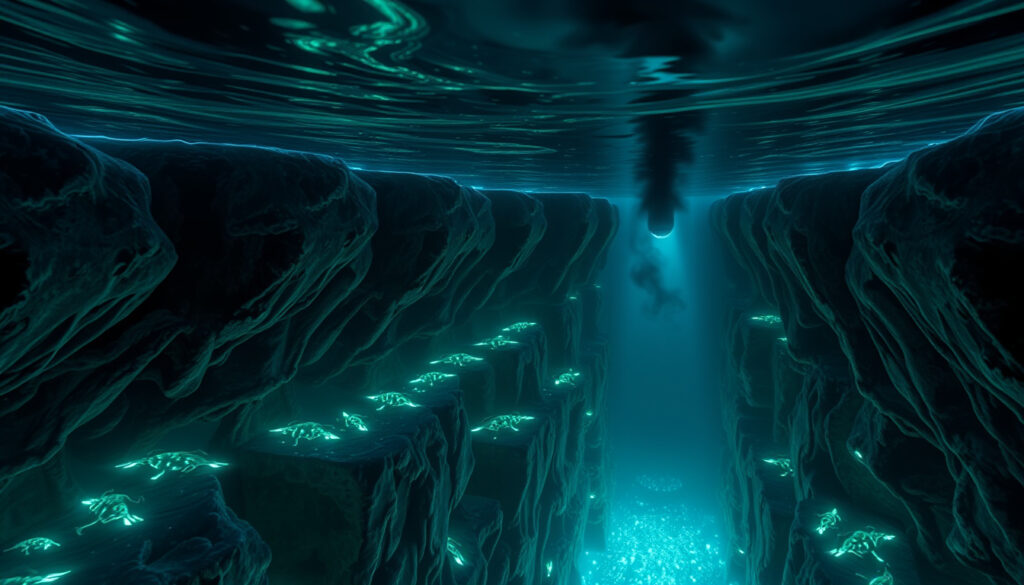
Deep Sea: Definition, Depth, Creatures & Future Changes | Guide
The deep sea is Earth’s largest living space, yet we know less about it than the surface of the Moon. This guide lays out what defines it, its deepest points, deadliest and smartest animals, and 2050 projections — all verified.
Depth threshold for deep sea: 200 meters (656 feet) ·
Deepest point on Earth: Challenger Deep, Mariana Trench – 10,994 meters (36,070 feet) ·
Ocean volume below 200 m: Approximately 90% of the world’s ocean ·
Estimated undiscovered species: Over 1 million (likely) ·
Human visits to deepest point: Fewer than 20 people (as of 2025)
Quick snapshot
- Deep sea begins at 200 m (NOAA Ocean Exploration)
- Challenger Deep reaches 10,994 m (Wikipedia)
- Less than 20% of ocean floor mapped (NOAA Ocean Service)
- Box jellyfish is most venomous marine animal (National Geographic)
- Exact number of deep-sea species (500,000 to 10 million estimated)
- Full climate-change impact on deep-sea ecosystems by 2050
- Whether deep-sea mining can be done without irreversible damage
- Precise effects of ocean acidification on hadal organisms
- Effectiveness of ISA regulations on deep-sea mining by 2026
- 1872–1876: First global ocean survey by HMS Challenger
- 1960: First human descent to Challenger Deep (Trieste)
- 2012: James Cameron’s solo dive to Challenger Deep
- 2025: Ongoing seabed mapping; Five Deeps Expedition completed 2019
Here are the key numbers at a glance.
| Attribute | Value |
|---|---|
| Deep sea depth threshold | 200 m (656 ft) |
| Maximum depth (Challenger Deep) | 10,994 m (36,070 ft) |
| Average temperature below 1,000 m | 2–4 °C (35–39 °F) |
| Pressure at 10,000 m | 1,000 atmospheres |
| Percentage of ocean explored | Less than 20% mapped, <5% explored in detail |
| Ocean volume below 200 m | About 90% of global ocean |
What defines the deep sea?
Depth and light thresholds
- The deep sea is defined as ocean waters below 200 meters (656 feet) according to NOAA Ocean Exploration (US government ocean authority).
- Sunlight begins to dwindle below 200 meters, making the deep ocean dark, cold, and food-poor — NOAA confirms no sunlight penetrates below 1,000 meters.
- The Smithsonian Ocean (natural history research institution) describes about three-fourths of the ocean as deep and permanently dark.
Temperature and pressure extremes
- The Woods Hole Oceanographic Institution (WHOI, marine research leader) states the bathypelagic zone averages about 4 °C.
- Pressures can exceed 1,000 atmospheres in the deepest trenches — equivalent to a person bearing the weight of 50 jumbo jets.
- The mesopelagic (200–1,000 m) is known as the twilight zone, per Museums Victoria (Australian science museum).
The vertical zones (mesopelagic to hadal)
- Mesopelagic (200–1,000 m): Twilight zone. Some light, but not enough for photosynthesis.
- Bathypelagic (1,000–4,000 m): Midnight zone. Perpetual darkness, near-freezing temperatures.
- Abyssopelagic (4,000–6,000 m): Abyssal plain. Uniformly cold and pressurized.
- Hadalpelagic (6,000 m to deepest trenches): Hadal zone. Seafloor trenches with extreme pressure.
Source: Smithsonian Ocean and WHOI
The pattern: Each zone demands entirely different adaptations. A fish at 200 meters cannot survive at 4,000 — the pressure alone would collapse its cells. The deep sea isn’t one environment; it’s a stack of distinct worlds.
What is the deepest sea in the world?
The Mariana Trench and Challenger Deep
- The deepest point on Earth is Challenger Deep in the Mariana Trench, at 10,994 meters (36,070 feet) — Wikipedia (collaborative reference database).
- The Mariana Trench is located in the western Pacific Ocean near Guam.
- Only fewer than 20 people have visited the bottom as of 2025 — more humans have walked on the Moon.
The five deeps project
- The Five Deeps Expedition (completed 2019) mapped the deepest points of all five oceans: Atlantic, Indian, Southern, Arctic, and Pacific.
- Lead explorer Victor Vescovo reached the bottom of each, setting records for deepest solo dives.
- National Geographic (geography and science publisher) reported findings from the expedition, including plastic debris found at 10,928 m in the Mariana Trench.
Other major deep ocean trenches
- Tonga Trench: Second deepest at 10,882 m
- Philippine Trench: 10,540 m
- Kermadec Trench: 10,047 m
- Japan Trench: 9,000 m
Source: Wikipedia – Deep sea
What this means: The deepest places on Earth are trenches — narrow, V-shaped scars in the ocean floor. They are not just deep; they are geologically active zones where tectonic plates collide.
Exploring the hadal zone costs millions per dive and carries extreme risk. The result: we have better maps of Mars than of the Mariana Trench floor.
The implication: Human exploration of these depths remains exceptionally rare.
What is the deadliest animal in the deep sea?
Venomous and bioluminescent predators
- The box jellyfish (Chironex fleckeri) is considered the most venomous marine animal — its venom can kill a human in under 5 minutes, per National Geographic.
- The stonefish has the most potent venom of any fish. Its dorsal spines deliver neurotoxins that cause paralysis and death if untreated.
- Many deep-sea creatures produce their own light through bioluminescence — Museums Victoria (Australian science museum) notes this is common in the twilight zone for luring prey.
The box jellyfish and stonefish
- Box jellyfish tentacles can reach 3 meters long and contain thousands of nematocysts (stinging cells).
- Stonefish blend into coral and rocky seabeds; their venom is heat-sensitive, and hot water is the recommended first aid.
- Both species are found in shallow tropical waters, not the deep sea — but they represent the pinnacle of marine venom evolution.
Deep-sea squids and their size
- The colossal squid (Mesonychoteuthis hamiltoni) is one of the largest invertebrates, reaching up to 14 meters long with eyes the size of dinner plates.
- Unlike the giant squid, the colossal squid has hooked tentacles and a sharp beak capable of cutting fish and even small whales.
- Encyclopaedia Britannica (academic reference publisher) describes the colossal squid as the largest invertebrate by mass.
The implication: Deadliest doesn’t mean biggest. The box jellyfish kills more humans annually than sharks, and it’s nearly transparent — you’d never see it coming.
Most deep-sea animals cannot survive at the surface due to decompression. Handling them after a deep-sea catch is fatal to the animal and potentially dangerous to the handler — some deep-sea fish have expandable stomachs and release undigested toxins when brought up.
The pattern: The most dangerous marine animals are often not the largest.
What is the most intelligent animal in our oceans?
Dolphins and their cognitive abilities
- Bottlenose dolphins consistently rank as the most intelligent marine animals, capable of self-recognition in mirrors, complex social hierarchies, and cooperative hunting.
- Research from BBC Bitesize (UK educational publisher) highlights dolphin problem-solving skills on par with some primates.
- Dolphins use signature whistles — individual names — to address each other across distances.
Cephalopod intelligence (octopus, squid)
- Octopuses are the closest thing to alien intelligence on Earth: they can open jars, solve mazes, and use tools.
- An octopus has two-thirds of its neurons in its arms, meaning each arm can “think” and solve problems independently.
- Some deep-sea octopuses, like the dumbo octopus, show escape behavior and problem-solving under experimental conditions.
Whales and problem-solving
- Killer whales (orcas) exhibit cultural learning — distinct groups have different hunting dialects and techniques passed down generations.
- The National Oceanography Centre (UK marine science institute) reports that whales use vocal communication across thousands of kilometers.
- Sperm whales, which dive to 2,000 meters for squid, coordinate group dives using echolocation and social clicks.
Why this matters: Intelligence in the ocean evolved differently. Dolphins have larger brains relative to body size than any non-human land mammal. Octopuses evolved intelligence entirely separately from vertebrates — proof that consciousness is not restricted to one lineage.
What will happen to the ocean in 2050?
Sea level rise projections
- Global sea levels could rise by 0.2 to 0.6 meters by 2050 depending on emissions scenarios, according to Earth.gov (US government climate portal).
- Thermal expansion — water expanding as it warms — accounts for about half of projected sea level rise.
- Melting ice sheets in Greenland and Antarctica are accelerating, adding more mass than previously modeled.
Ocean acidification effects
- Oceans have absorbed about 30% of human-caused CO₂, causing a 26% increase in acidity since the industrial revolution.
- Acidification reduces the availability of calcium carbonate, which deep-sea corals require to build their skeletons.
- NOAA Ocean Service (US federal ocean agency) warns that deep-sea coral ecosystems may shrink by up to 70% in high-emission scenarios by 2100.
Deep-sea ecosystem shifts
- Warming surface waters reduce oxygen levels, expanding “dead zones” where deep-sea creatures suffocate.
- Deep-sea fisheries may decline significantly because species adapted to cold, stable temperatures cannot migrate fast enough.
- National Geographic reports that some seamount ecosystems could see species loss of 30–50% by mid-century.
The catch: The deep sea is not insulated from climate change. Even though the surface warms faster, deep currents will carry warmer, more acidic water downward. A change of 1 °C in the abyss is catastrophic for organisms accustomed to stable near-freezing temperatures.
What is another word for ‘deep sea’?
Abyssal zone
- The abyssal zone refers specifically to depths of 4,000–6,000 meters, covering vast flat plains on the ocean floor.
- This zone experiences near-freezing temperatures (2–3 °C), high pressure, and complete darkness.
- Smithsonian Ocean notes that abyssal plains cover more than 50% of Earth’s surface.
Deep ocean
- “Deep ocean” is used interchangeably with “deep sea” in most scientific contexts.
- NOAA consistently uses “deep ocean” in its official publications for waters below 200 meters.
- The Encyclopaedia Britannica treats both terms as synonymous for oceanography.
Hadal zone
- The hadal zone (named after Hades, god of the underworld) applies to depths below 6,000 meters, exclusively in ocean trenches.
- This zone accounts for less than 1% of the ocean floor but contains some of the most extreme life on Earth.
- Only about 5% of hadal areas have been explored directly by humans or ROVs.
What this means: The deep sea has a precise vocabulary. “Abyssal” is not a synonym for “deep sea” — it’s a specific depth band within it. Using terms precisely matters for science communication and policy.
The deep sea is not one place but four distinct vertical zones, each with unique conditions and life forms. Most resources lump them together — knowing the difference is what separates casual readers from informed advocates.
What this means: Knowing these terms helps in reading scientific literature.
Deep sea comparison: zones, conditions, and key species
Four vertical zones, four radically different environments. The following table shows how conditions change from the twilight zone to the deepest trenches.
| Zone | Depth range | Temperature | Key species |
|---|---|---|---|
| Mesopelagic (twilight) | 200–1,000 m | 5–10 °C | Lanternfish, hatchetfish, deep-sea squid |
| Bathypelagic (midnight) | 1,000–4,000 m | ~4 °C | Anglerfish, gulper eel, giant spider crab |
| Abyssopelagic (abyssal) | 4,000–6,000 m | 2–3 °C | Abyssal grenadier, sea cucumbers, glass sponges |
| Hadalpelagic (hadal) | 6,000–11,000 m | 1–2 °C | Amphipods, snailfish, foraminifera |
Source: Smithsonian Ocean, Museums Victoria, WHOI
The pattern: As depth increases, temperature drops, pressure rises, and food becomes scarcer. Only the most specialized species survive below 4,000 meters — and they require genetic and physiological adaptations that took millions of years to evolve.
Timeline: Key events in deep sea exploration
| Date/Period | Event | Significance |
|---|---|---|
| 1872–1876 | HMS Challenger expedition | First global oceanographic survey; coined “deep sea” |
| 1960 | Trieste bathyscaphe descent | First human visit to Challenger Deep (10,911 m) |
| 1995 | Kaiko ROV reaches Mariana Trench | First unmanned vehicle to return samples from hadal zone |
| 2012 | Deepsea Challenger solo dive | James Cameron’s solo dive to Challenger Deep |
| 2019 | Five Deeps Expedition completed | Victor Vescovo visited deepest point of all five oceans |
| 2025 | Ongoing mapping efforts | Seabed 2030 project aims to map entire ocean floor |
Source: Wikipedia – Deep sea, National Geographic
The implication: From 1872 to 1960, it took 88 years to go from the first deep-sea survey to a human reaching the deepest point. In the next 60 years, only 18 more people followed. Deep-sea exploration is not progressing fast — it remains one of the most exclusive and dangerous frontiers on Earth.
Confirmed facts and unanswered questions
Confirmed facts
- Challenger Deep depth is 10,994 m (±11 m) — Wikipedia
- Deep sea starts at 200 m, consistent across scientific bodies — NOAA
- Box jellyfish venom can kill humans in minutes — National Geographic
- Dolphins show self-recognition in mirrors — BBC Bitesize
- Sea levels could rise 0.2–0.6 m by 2050 — Earth.gov
- Less than 20% of the ocean floor is mapped — NOAA Ocean Service
Questions that remain unclear
- Exact number of deep-sea species — estimates range from 500,000 to 10 million
- Full impact of climate change on deep-sea ecosystems by 2050
- Whether deep-sea mining can be done without irreversible damage
- How much plastic pollution has accumulated in the hadal zone
- Whether deep-sea organisms can adapt to warmer, acidified conditions
- Effectiveness of ISA regulations on deep-sea mining by 2026
The implication: The gaps in our knowledge are as significant as what we know.
Quotes from experts and institutions
“The deep sea is the largest ecosystem on the planet, yet it is the least understood. We have better maps of Mars than we do of the ocean floor below 200 meters.”
— Dr. Alan Jamieson, Marine Biologist, ICES Journal of Marine Science (2025)
“Deep-sea creatures have evolved remarkable adaptations — from bioluminescent lures to transparent bodies — to survive in conditions that would crush or freeze most other life on Earth.”
— National Oceanography Centre, UK, Deep Sea Creatures
“The animals of the deep sea are not just curiosities — they are living evidence of life’s ability to survive in extreme environments, and they hold clues to understanding both our planet’s past and the possibility of life on other worlds.”
— Monterey Bay Aquarium, Into the Deep exhibit
“What happens in the deep sea affects the whole planet. These ecosystems regulate climate, cycle nutrients, and support fisheries — yet we are still treating them as an infinite resource.”
— National Geographic, Deep Sea coverage
Each of these speakers brings a different lens: a deep-sea biologist quantifying the unknown, a national research institution cataloging adaptations, an aquarium fostering public connection, and a publisher framing the planetary stakes. Together, they paint a picture of a frontier that is scientifically vital and increasingly vulnerable.
pmc.ncbi.nlm.nih.gov, neal.fun, oceantoday.noaa.gov, ipcc.ch, oceanexplorer.noaa.gov, ocean-climate.org, sciencedirect.com, youtube.com
For a closer look at how these creatures survive extreme conditions, explore the remarkable deep-sea fish adaptations that allow them to thrive in crushing pressure and perpetual darkness.
Frequently asked questions
How deep is the deep sea exactly?
The deep sea is defined as ocean waters below 200 meters (656 feet). This is the depth at which sunlight begins to fade and where pressure, temperature, and darkness define a distinct environment (NOAA).
What pressure exists at the bottom of the ocean?
At 10,000 meters depth, pressure exceeds 1,000 atmospheres — over 1,000 times the pressure at sea level. That is equivalent to having 50 jumbo jets stacked on your chest (Smithsonian Ocean).
Can deep-sea creatures live in an aquarium?
Most cannot survive at surface pressure. Their bodies are adapted to extreme pressure, and rapid decompression typically kills them. Specialized pressurized tanks exist in research aquariums but are rare and expensive (Monterey Bay Aquarium).
How do deep-sea animals produce light?
Through bioluminescence — a chemical reaction involving luciferin and luciferase. Over 90% of deep-sea animals produce light, used for luring prey, attracting mates, or camouflage (Museums Victoria).
Is deep-sea mining dangerous?
Environmental scientists warn it could cause irreversible damage by destroying seafloor habitats, releasing sediment plumes, and killing slow-growing deep-sea corals. The International Seabed Authority (ISA) is developing regulations expected by 2026 (National Geographic).
What is the temperature in the deep sea?
Below 1,000 meters, temperatures range from 2–4 °C (35–39 °F). Near the seabed in deep trenches, temperatures can drop to 1–2 °C (WHOI).
How many humans have visited Challenger Deep?
Fewer than 20 people as of 2025. This includes the Trieste crew (1960), James Cameron (2012), and members of the Five Deeps Expedition (2019). More people have walked on the Moon (Wikipedia).
What is the biggest deep-sea creature?
The colossal squid (Mesonychoteuthis hamiltoni) is the largest invertebrate by mass, reaching up to 500 kg and 14 meters in length. The blue whale is larger but spends most of its time near the surface (Encyclopaedia Britannica).
The deep sea remains Earth’s final frontier — a vast, pressurized, permanently dark world that holds keys to understanding life’s limits, climate regulation, and even our own future on a changing planet. For readers interested in ocean conservation, the choice is clear: advocate for better protections on deep-sea mining, support ocean mapping initiatives, and recognize that every decision on carbon emissions directly alters conditions miles below the surface. The deep sea may be out of sight, but it is not beyond consequence.
Related reading: Ocean Ramsey: Shark Conservation · Tasmanian Tiger: Extinction and De-Extinction
More related posts
 Max McNown: Biography, Marriage, Songs & Cade McNown Connection
 Jake Gyllenhaal Relationship Status: Current Partner and History
 George Michael: Cause of Death, Inheritance & Last Words
 Deco Hotel Canberra – Reviews Location Rates Guide
 Paint Shop Near Me: Ireland Stores, Prices & Guides
 Kaitlin Olson: Separating fact from Olsen twins rumors
 New York Weather November 2024: Read Forecasts Like a Pro
 Ray Romano: Family, Net Worth, Why Everybody Loves Raymond Ended
