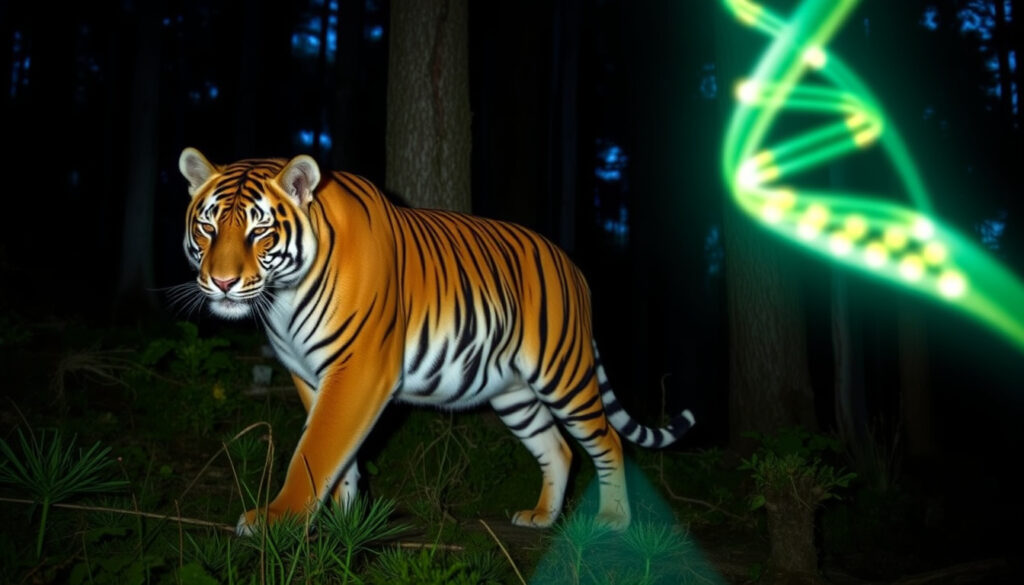
Tasmanian Tiger: Extinction, DNA, and De-Extinction Explained
There’s something about the Tasmanian tiger that refuses to let go of the imagination — a striped, pouch-backed marsupial that was the largest carnivore of its kind before the last known animal died in captivity in 1936. This article traces the thylacine’s verified history, from its extinction at Beaumaris Zoo to the DNA evidence that has made it a prime candidate for de-extinction, showing what’s actually known, what remains uncertain, and where the science stands today.
Scientific name: Thylacinus cynocephalus ·
Last confirmed death: 1936, Beaumaris Zoo, Tasmania ·
Native range: Australia, Tasmania, Papua New Guinea ·
Body length: 100–130 cm (39–51 in) ·
Weight: 15–30 kg (33–66 lb)
Quick snapshot
- Extinct since 1936 (Colossal Biosciences)
- DNA extracted from museum specimens (Colossal Biosciences)
- Colossal is actively working on de-extinction (ABC News)
- Whether any thylacine survived after 1936 in the wild
- Whether de-extinction will ultimately succeed
- Exact cause of extinction beyond hunting
- Last wild thylacine shot: 1930 (CBS News)
- Last captive death: 7 Sept 1936, Beaumaris Zoo (CBS News)
- IUCN declared extinct: 1986 (ABC News)
- Colossal project announced: 2022 (Colossal Biosciences)
- Colossal aims for first de-extinct thylacine by 2027 (Colossal Biosciences)
- Peer-reviewed papers expected soon (ABC News)
Eight key facts, one pattern: the thylacine was a medium-sized carnivore built for stealth, not speed.
| Attribute | Details |
|---|---|
| Scientific name | Thylacinus cynocephalus |
| Common names | Tasmanian tiger, Tasmanian wolf, thylacine |
| Last confirmed death | 7 September 1936, Beaumaris Zoo, Hobart |
| Conservation status | Extinct (IUCN) |
| Body length | 100–130 cm (39–51 in) |
| Weight | 15–30 kg (33–66 lb) |
| Diet | Carnivorous: kangaroos, wallabies, birds |
| Range | Tasmania, Australia, Papua New Guinea |
What this means: The thylacine’s body plan — a long stiff tail, powerful jaws, and 46 sharp teeth — made it an apex marsupial predator, but its relatively small population size left it vulnerable to human pressures.
Can the Tasmanian tiger still exist?
What is the thylacine?
- The thylacine (Thylacinus cynocephalus) was the largest carnivorous marsupial to survive into modern times and the only member of the family Thylacinidae that persisted into the 20th century (Colossal Biosciences).
- It carried 15–20 dark stripes across its back from shoulders to tail, which gave it the “tiger” name, and had 46 sharp teeth adapted for gripping prey (Colossal Biosciences).
- Despite the nickname, it was a marsupial — not a tiger, not a wolf. Females had a rear-opening pouch where they carried their young.
Official status from the IUCN has listed the thylacine as extinct since 1986. No confirmed wild sighting has been accepted by the scientific community since 1936.
Are there any confirmed sightings since 1936?
- No verified sightings have been accepted by the scientific community since the last captive death in 1936.
- Unconfirmed reports, photographs, and footprints continue to surface — none have met the burden of evidence required for official recognition.
- Some researchers point to rock art in Australia that may depict thylacines after 1936, but dating and species identification remain inconclusive.
The forty thousand unconfirmed sighting reports highlight the persistent belief in survival despite a complete lack of verifiable evidence.
The pattern: Belief in the thylacine’s survival persists because the animal held on so long in remote areas, but the evidence gap has only widened with every failed search expedition.
When was the last Tasmanian tiger dead?
What happened at Beaumaris Zoo in 1936?
- The last known thylacine died on 7 September 1936 at Beaumaris Zoo in Hobart, Tasmania (CBS News).
- The animal was a male named Benjamin, who was locked out of his shelter during a cold Hobart night and died of exposure.
- Benjamin’s death marked the official extinction endpoint for the species.
Who was the last thylacine?
- Benjamin was captured in the Florentine Valley in Tasmania in 1933 and lived at Beaumaris Zoo for roughly three years.
- Film footage of Benjamin pacing his enclosure — the famous black-and-white clip — remains the most commonly referenced visual record of a living thylacine.
- After Benjamin died, the species was declared extinct, though the IUCN did not formally classify it as Extinct until 1986.
“The thylacine had been extinct for decades and was declared extinct before the recent genome breakthrough claims.”
CBS News, reporting on the timeline of extinction and de-extinction efforts
Why this matters: The circumstance of Benjamin’s death — neglect, not a deliberate act — makes the extinction feel less like an inevitable tragedy and more like a preventable one, which partly fuels the emotional push for de-extinction.
Is there DNA from a Tasmanian tiger?
What is the quality of thylacine DNA?
- Colossal Biosciences began its genome work with a genome sequenced by Dr. Andrew Pask in 2018 from DNA extracted from a 108-year-old specimen (Colossal Biosciences).
- The thylacine genome was updated in April 2022, and by October 2024 Colossal had produced a reconstructed genome it described as more than 99.9% accurate (ABC News).
- As of October 2024, the genome still had 45 gaps that Colossal planned to close with additional sequencing (CBS News).
How is Colossal Biosciences using thylacine DNA?
- Colossal reported isolating long RNA molecules from a 110-year-old thylacine head preserved in ethanol, sampling tissue from the tongue, nasal cavity, brain, and eye (CBS News).
- The team edited more than 300 unique genetic changes into a fat-tailed dunnart cell — the closest living relative of the thylacine — calling it the most edited animal cell to date (CBS News).
- Colossal is sequencing the fat-tailed dunnart genome in collaboration with the University of Melbourne to compare it with preserved thylacine DNA (Colossal Biosciences).
Colossal claims a 99.9% accurate genome, but the 45 remaining gaps and the absence of peer-reviewed publication mean the scientific community has not yet validated the claim. Dr. Andrew Pask has said peer-reviewed papers are expected early in the coming year.
The trade-off: A 99.9% complete genome with 45 gaps is a remarkable technical achievement for an extinct species, but the final 0.1% may contain regulatory elements critical for healthy development — and those gaps cannot be sequenced from degraded museum DNA.
Why is the Tasmanian tiger so special?
What made the thylacine unique among marsupials?
- It was the largest carnivorous marsupial of modern times, filling a role similar to wolves and big cats in other ecosystems.
- Unlike most marsupials, both male and female thylacines had a pouch — the male pouch was unique among marsupials and may have protected the genitals during dense brush movement.
- Its jaw could open to an extraordinary 80–90 degrees, giving it a distinctive, almost reptilian gape.
How did the thylacine get its tiger stripes?
- The thylacine’s 15–20 dark stripes ran across its lower back and rump, resembling a tiger’s markings — hence the common name “Tasmanian tiger” (Colossal Biosciences).
- The stripes were not just superficial; they extended into the skin, meaning they were part of the animal’s natural pigmentation pattern rather than fur coloration alone.
- Each individual had a unique stripe pattern, allowing researchers to identify individual animals from historical photographs.
“The thylacine was the only member of the family Thylacinidae to survive into modern times.”
Colossal Biosciences species page
The pattern: The thylacine wasn’t just another extinct species — it was an entire evolutionary branch that ended in a zoo enclosure on one cold September night.
Are Tasmanian tigers still alive in 2026?
What do rock art suggest about survival?
- Some rock art sites in northern Australia show striped quadrupedal animals that some researchers interpret as thylacines.
- Dating of these artworks is imprecise, and the markings could represent other animals, including the thylacine’s smaller relative, the numbat.
- No rock art has been accepted as definitive evidence of post-1936 survival.
What is the official conservation status?
- The IUCN Red List classifies the thylacine as Extinct, with the last confirmed record being Benjamin’s death in 1936.
- Tasmania’s Department of Natural Resources and Environment maintains a “sighting reporting” system, but no submitted report has ever been verified.
- As of 2026, no credible evidence — hair, scat, camera-trap image, or DNA — has surfaced that would challenge the extinction classification.
De-extinction is not rediscovery. Even if Colossal successfully births a thylacine in 2027, that animal would be a genome-edited proxy — not a surviving wild population. The two claims are separate, and confusing them muddles the science.
The implication: For anyone hoping the thylacine survived in secret, the evidence is simple: forty thousand reported sightings over ninety years, and not a single one passed scientific scrutiny. The animal is gone. The question is whether we can build a version of it.
Timeline: The rise and fall of the thylacine
Seven milestones, one trajectory: from widespread apex predator to a single enclosure in Hobart.
| Date / Period | Event |
|---|---|
| Pre-1800 | Thylacine widespread across Australia and Tasmania |
| 1800s | European settlers hunt thylacine for killing sheep |
| 1930 | Last wild thylacine shot |
| 7 September 1936 | Last captive thylacine dies at Beaumaris Zoo |
| 1986 | IUCN declares thylacine extinct |
| 2022 | Colossal Biosciences announces de-extinction project |
| 2027 (projected) | Colossal aims to birth first de-extinct thylacine (Colossal Biosciences) |
What this means: The gap between the last wild death (1930) and the first de-extinction target (2027) is less than a century — short enough that preserved tissue still contains RNA, long enough that the species’ ecological niche has been filled by other predators.
What we know and what we don’t
Confirmed facts
- The thylacine is extinct since 1936 (Colossal Biosciences)
- DNA has been extracted from museum specimens (Colossal Biosciences)
- Colossal Biosciences is actively working on de-extinction (ABC News)
- A reconstructed genome at >99.9% accuracy has been claimed (CBS News)
What remains uncertain
- Whether any thylacine survived after 1936 in the wild
- Whether de-extinction will produce a viable, healthy animal
- Whether the 45 gaps in the genome contain critical regulatory elements
- Whether a genome-edited dunnart proxy qualifies as a true thylacine
- Exact weight of hunting vs. disease vs. habitat loss in the extinction
“Some scientists remained unconvinced that de-extinction is possible despite the thylacine advances.”
ABC News, October 2024
The catch: The gap between what Colossal has announced (a 99.9% accurate genome, RNA from a 110-year-old head, 300+ edits in dunnart cells) and what has been peer-reviewed remains unfilled. Until that gap closes, the project sits in a space between breakthrough and marketing.
For the Tasmanian tiger, the story is not just about loss. It is about what we choose to do with the fragments that remain — DNA sequences, preserved heads, grainy film footage. Colossal Biosciences has bet that those fragments are enough to reconstruct an entire species. The next few years will reveal whether that bet pays off, or whether some extinctions are final no matter how good the genome gets. For anyone watching from Tasmania or elsewhere, the choice is clear: support the science, wait for the data, and don’t mistake a lab-born proxy for a wild animal that has been gone for ninety years.
Frequently asked questions
What is the difference between a Tasmanian tiger and a tiger?
The Tasmanian tiger (thylacine) was a carnivorous marsupial native to Australia and Tasmania, while a tiger (Panthera tigris) is a placental mammal from Asia. They are not closely related — the thylacine is a marsupial, the tiger is a feline.
How many Tasmanian tigers were there at peak?
At the time of European settlement, the thylacine population in Tasmania was estimated at around 5,000 individuals. Mainland Australia populations had already declined significantly before European contact.
What did the Tasmanian tiger eat?
The thylacine was carnivorous, preying on kangaroos, wallabies, birds, and small mammals. European settlers also blamed them for killing sheep, though this was likely exaggerated.
Where did the Tasmanian tiger live?
The thylacine originally ranged across mainland Australia, Tasmania, and Papua New Guinea. By the time of European settlement, it was confined to Tasmania in eucalypt forests, grasslands, and coastal heath.
How long did a Tasmanian tiger live?
In captivity, thylacines lived approximately 7–9 years. Their lifespan in the wild is not precisely known, but estimates suggest similar or slightly shorter durations due to predation and competition.
What is the Tasmanian tiger sound like?
Historical accounts describe the thylacine’s vocalizations as a series of short, sharp barks or coughs, often repeated in succession. Audio recordings from the 1930s at zoos capture these sounds, though quality is poor.
Is the Tasmanian tiger a cat or a dog?
Neither. The thylacine was a marsupial, not a placental mammal. It was not a cat, dog, or wolf. Its common names — Tasmanian tiger and Tasmanian wolf — refer to superficial resemblance, not biological relationship.
What is the Tasmanian tiger baby called?
A baby thylacine is called a joey, like all marsupial young. Thylacine joeys were carried in the mother’s rear-opening pouch until they were large enough to leave.
More related posts
 What Is Dementia – Symptoms, Types, Causes and Stages
 Oliver Cromwell: What He Did, Controversies, and Legacy
 Zooey Deschanel: Biography, Family, Kids, and Relationship Facts
 Rosie Huntington-Whiteley: Age, Children, and Jason Statham
 Addison Rae: Biography, Career, and Net Worth
 Jordana Brewster: Age, Kids, Net Worth & Paul Walker
 Shannon Neale: Age, Height, Contract & Relation to Lachie Neale
 Iran News Today: Hormuz Ship Seizures & Trump Updates
