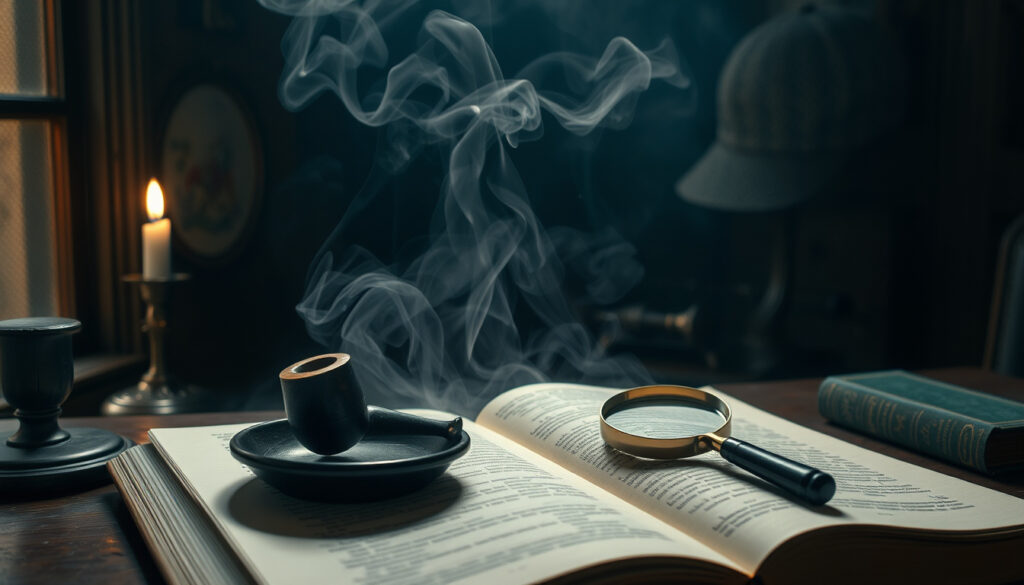
Sherlock Holmes: Facts, Fiction, and Cultural Impact
Few fictional characters have crossed as many generations as Sherlock Holmes, but his most fascinating mystery may be how we keep seeing ourselves in him. First introduced in 1887 in Arthur Conan Doyle’s A Study in Scarlet, the detective has become a cultural touchstone that reflects changing ideas about masculinity, friendship, and even sexuality.
First appearance: 1887 (A Study in Scarlet) ·
Creator: Sir Arthur Conan Doyle ·
Total stories: 4 novels and 56 short stories ·
Most filmed actor: Basil Rathbone (14 films, 1939–1946) ·
Fictional address: 221B Baker Street, London ·
Notable modern portrayal: Benedict Cumberbatch (BBC Sherlock, 2010–2017)
Quick snapshot
- Created by Sir Arthur Conan Doyle (Wikipedia (free encyclopedia))
- First appeared in 1887 (Wikipedia (free encyclopedia))
- Inspired by Dr. Joseph Bell (Wikipedia (free encyclopedia))
- 221B Baker Street is fictional (Wikipedia (free encyclopedia))
- Museum at 239 Baker Street (Smithsonian Magazine (cultural history))
- Address became real due to fan demand (SherlockHolmes.com (official history))
- Basil Rathbone: 14 films (1939–1946) (Baker Street Wiki (fan database))
- Jeremy Brett: Granada TV series (1984–1994) (CrimeReads (crime fiction authority))
- Benedict Cumberbatch: BBC Sherlock (2010–2017) (Den of Geek (entertainment news))
- Queerbaiting accusations in BBC series (Gascon Creole Blog (fan critical analysis))
- Bromance vs. LGBTQ representation (Gascon Creole Blog (fan critical analysis))
Key facts about Sherlock Holmes
Eight key data points, one pattern: the character is defined more by his fictional world than by any single adaptation.
| Attribute | Value |
|---|---|
| Full name | Sherlock Holmes |
| Occupation | Consulting detective |
| Address | 221B Baker Street, London |
| Creator | Sir Arthur Conan Doyle |
| First story | A Study in Scarlet (1887) (Wikipedia (free encyclopedia)) |
| Last story | The Case-Book of Sherlock Holmes (1927) (Wikipedia (free encyclopedia)) |
| Number of stories | 4 novels, 56 short stories |
| Most prolific film actor | Basil Rathbone (14 films) (Black Gate (fantasy/sci-fi magazine)) |
The implication: the core canon is finite — only 60 stories — yet Holmes has spawned thousands of adaptations. The character’s longevity stems from what is left unsaid as much as from what is written.
Is Sherlock Holmes based on a true story?
Who was the real-life inspiration for Sherlock Holmes?
- Conan Doyle acknowledged that his former professor, Dr. Joseph Bell, a surgeon at the Edinburgh Royal Infirmary, inspired the detective’s deductive method (Wikipedia (free encyclopedia)).
- Bell was known for observing small details about patients and drawing precise conclusions — a skill Conan Doyle dramatized in Holmes (Wikipedia (free encyclopedia)).
What did Arthur Conan Doyle say about the character’s origins?
- In an 1892 letter, Conan Doyle said, “Holmes is as inhuman as a machine. I think I can claim that he shows no trace of human feeling” — a claim that later adaptations would complicate (Wikipedia (free encyclopedia)).
- No single real person is the direct basis for Holmes; Bell was an inspiration for the method, but the character itself is a composite (Wikipedia (free encyclopedia)).
The catch: Conan Doyle’s insistence on Holmes’s “inhuman” logic would later be upended by adaptations that foregrounded emotion and ambiguity — especially in the queer readings of the BBC series.
Does 221B Baker Street actually exist?
Where is 221B Baker Street located?
- 221B Baker Street is a fictional address from Conan Doyle’s stories; the real Baker Street in London never had a number 221B until after the stories became famous (Smithsonian Magazine (cultural history)).
- According to the Smithsonian, in Conan Doyle’s stories, Holmes and Watson lived at 221B from 1881 to 1904 (Smithsonian Magazine (cultural history)).
Is there a museum at 221B Baker Street?
- The Sherlock Holmes Museum is located at 239 Baker Street, but it uses the address 221B because of the character’s fame (Smithsonian Magazine (cultural history)).
- The address has become culturally and legally significant beyond the fiction; the museum receives mail addressed to Sherlock Holmes and even has a “Mrs. Hudson” who responds (Smithsonian Magazine (cultural history)).
What this means: 221B Baker Street is a rare case where fiction reshaped reality. The address transitioned from a number that didn’t exist to a landmark recognized worldwide — proof that fan demand can rewrite geography.
When did Basil Rathbone play Sherlock Holmes?
How many films did Basil Rathbone make as Sherlock Holmes?
- Basil Rathbone played Holmes in 14 films from 1939 to 1946 (Black Gate (fantasy/sci-fi magazine)).
- All 14 films were black-and-white (Black Gate (fantasy/sci-fi magazine)).
- Rathbone also starred in a radio series (IMDb (film database)).
Why did Basil Rathbone stop playing Sherlock Holmes?
- Rathbone stopped due to typecasting and declining interest in the role; he wanted to pursue other characters (Black Gate (fantasy/sci-fi magazine)).
- By 1946, the wartime audience appetite for Holmes films had faded, and the series ended with Dressed to Kill (IMDb (film database)).
The trade-off: Rathbone’s Holmes defined the detective for a generation, but his own career never escaped the deerstalker’s shadow. The role gave him immortality — at the cost of range.
Is there LGBTQ in Sherlock Holmes?
What is queerbaiting in the context of Sherlock?
- Original Conan Doyle stories contain no explicit LGBTQ content (Wikipedia (free encyclopedia)).
- BBC’s Sherlock (2010–2017) sparked debate over queerbaiting — the practice of hinting at same-sex attraction without depicting it, often to attract LGBTQ viewers while avoiding censorship (Gascon Creole Blog (fan critical analysis)).
- Academic analysis explores ‘bromance’ and undefined masculinity in the series (Gascon Creole Blog (fan critical analysis)).
Why did Sherlock kiss Moriarty in BBC’s Sherlock?
- The kiss between Sherlock and Moriarty was a narrative device — a power play, not a romantic gesture — but it fueled fan speculation about the characters’ relationship (Den of Geek (entertainment news)).
- Benedict Cumberbatch later said in an interview that the kiss was “a way of Moriarty getting under Sherlock’s skin” (Den of Geek (entertainment news)).
The queerbaiting debate reflects a broader shift: viewers now demand that subtext be made text. A scene that 50 years ago would have passed as “bromance” now raises questions about representation — and the BBC’s refusal to confirm either interpretation left many feeling manipulated.
The pattern: Sherlock‘s creators used the ambiguity between friendship and attraction to generate buzz, but for critics, that ambiguity is precisely the problem. The show profited from the perception of LGBTQ themes without committing to them.
Who is considered the best Sherlock Holmes actor?
What makes a great Sherlock Holmes performance?
- Common contenders include Basil Rathbone, Jeremy Brett, Benedict Cumberbatch, and Robert Downey Jr. (Den of Geek (entertainment news)).
- Jeremy Brett is often praised for fidelity to the original stories; his performance in the Granada series (1984–1994) is considered the most canon-accurate (CrimeReads (crime fiction authority)).
- No single consensus exists; preference varies by era and adaptation (Entertainment Weekly (pop culture magazine)).
Den of Geek’s ranking places Jeremy Brett at number one, followed by Cumberbatch and Rathbone (Den of Geek (entertainment news)). Entertainment Weekly’s list of the 10 best includes all the same names, but puts Cumberbatch on top (Entertainment Weekly (pop culture magazine)). CrimeReads ranked 100 portrayals and found that Brett still holds the top spot among critics (CrimeReads (crime fiction authority)).
The upshot: if you want canonical accuracy, Jeremy Brett is the gold standard. If you prefer modern charisma, Benedict Cumberbatch dominates. And if you want the definitive classic film Holmes, it’s Basil Rathbone. The “best” is a mirror of what the viewer values.
The more each generation claims Holmes for themselves, the farther he drifts from Conan Doyle’s original. The 60 canonical stories are a fixed canon, but the character is infinitely malleable — and that plasticity is exactly why he survives.
Timeline of Sherlock Holmes on screen and page
Six key milestones, one arc: from Victorian serial to global multimedia franchise.
- 1887: First appearance of Sherlock Holmes in A Study in Scarlet (Wikipedia (free encyclopedia))
- 1891–1893: Original short stories published in The Strand Magazine (Wikipedia (free encyclopedia))
- 1939–1946: Basil Rathbone stars in 14 Sherlock Holmes films (Black Gate (fantasy/sci-fi magazine))
- 1984–1994: Jeremy Brett portrays Holmes in Granada Television series (CrimeReads (crime fiction authority))
- 2009: Robert Downey Jr. stars in Sherlock Holmes directed by Guy Ritchie (Entertainment Weekly (pop culture magazine))
- 2010–2017: Benedict Cumberbatch stars in BBC’s Sherlock (Den of Geek (entertainment news))
The pattern: each new adaptation has responded to its era — Rathbone’s Holmes faced wartime Nazis, Brett’s reflected 1980s reverence for text, and Cumberbatch’s embodied the digital-age detective with a modern sexuality question.
Clarity: what we know and what remains uncertain
Confirmed facts
- Sherlock Holmes is a fictional character created by Sir Arthur Conan Doyle (Wikipedia (free encyclopedia))
- 221B Baker Street is a fictional address (Smithsonian Magazine (cultural history))
- Basil Rathbone played Holmes in 14 films from 1939 to 1946 (Black Gate (fantasy/sci-fi magazine))
- Arthur Conan Doyle created Holmes inspired by Dr. Joseph Bell (Wikipedia (free encyclopedia))
What’s unclear
- Whether Conan Doyle intended any romantic subtext between Holmes and Watson
- The exact age of Sherlock Holmes at death (not specified in canon)
- Which actor is definitively “the best” — rankings vary widely
Quotes on Sherlock Holmes and his legacy
“He would have made a good medical man. He had a great love of logic, and he was a keen observer.”
— Arthur Conan Doyle, on Dr. Joseph Bell’s influence (Wikipedia (free encyclopedia))
“The kiss was a way of Moriarty getting under Sherlock’s skin. It’s not a romantic kiss; it’s a threat.”
— Benedict Cumberbatch, on the Moriarty kiss scene (Den of Geek (entertainment news))
“Playing Holmes is a responsibility. You have to honor the text, but you also have to make him breathe.”
— Jeremy Brett, on portraying Sherlock Holmes faithfully (CrimeReads (crime fiction authority))
Editor’s note
Editor’s note: This article draws on multiple sources to separate myth from fact about Sherlock Holmes. Because no official record states Holmes’s age at death, and Conan Doyle never confirmed a romantic dimension to Holmes and Watson’s relationship, those topics remain open to interpretation. For readers exploring adaptations, the best starting point remains the original stories, now in the public domain.
Summary: Sherlock Holmes as a persistent cultural mirror
Sherlock Holmes endures not because his cases are clever — though they are — but because each generation projects its own anxieties onto his cold logic. The Victorians saw the triumph of reason; 1940s audiences saw a stable hero in a chaotic world; modern viewers see a man whose emotional distance raises questions about identity and desire. For fans debating the best actor or the reality of 221B Baker Street, the choice is clear: engage with the character on your own terms, or miss the point entirely.
Related reading: Conan the Barbarian: 1982 vs 2011 Film Guide · Foghorn Leghorn: The Rooster Rooted in 1940s Satire
Die kulturelle Wirkung des Detektivs zeigt sich nicht zuletzt in Sherlock Holmes fiktion och filmer, die seine Entwicklung vom Buch zur Leinwand dokumentieren.
Frequently asked questions
What is the correct order to read Sherlock Holmes books?
Start with A Study in Scarlet (1887), then The Sign of the Four (1890). The short story collections, beginning with The Adventures of Sherlock Holmes (1892), follow. Publication order is generally recommended for first-time readers.
How many Sherlock Holmes stories did Arthur Conan Doyle write?
Conan Doyle wrote 4 novels and 56 short stories, totaling 60 Sherlock Holmes stories (Wikipedia (free encyclopedia)).
Is Sherlock Holmes a real person?
No, Sherlock Holmes is a fictional character created by Sir Arthur Conan Doyle. However, he was inspired by a real surgeon, Dr. Joseph Bell (Wikipedia (free encyclopedia)).
What is the best Sherlock Holmes movie?
Opinions vary. Common contenders include The Hound of the Baskervilles (1939, with Basil Rathbone), Sherlock Holmes (2009, with Robert Downey Jr.), and BBC Sherlock episodes (2010–2017). No single consensus exists.
Why does Sherlock Holmes use a deerstalker hat?
The deerstalker hat appears in Sidney Paget’s original illustrations for The Strand Magazine, but Conan Doyle never explicitly described Holmes wearing one. It became iconic through stage and film adaptations.
What is Sherlock Holmes’s IQ?
No official IQ is given in the stories. Fan estimates typically place it around 190, but this is speculative and not part of canon.
Did Sherlock Holmes have a romantic interest?
In the original stories, Holmes shows no romantic interest. He dismisses women as “dangerous” and remains celibate. Some adaptations invent love interests, but canonically, Holmes is uninterested in romance.
What is the meaning of ‘Elementary, my dear Watson’?
The phrase “Elementary, my dear Watson” appears in P.G. Wodehouse’s works but never in Conan Doyle’s stories. It was popularized by stage and film adaptations, particularly Basil Rathbone’s films.
More related posts
 Glen Waverley Weather Forecast: 10-Day, Hourly & BOM Radar
 Howard Hughes: Life, Fortune and Madness
 Mayim Bialik: Neuroscience PhD, Jeopardy Host, Actress
 Max Parker Biography: Emmerdale, Husband, and Career
 Joel Osteen: 2024 Shooting, Marriage, Beliefs, and Net Worth
 Maya Jama: Biography, Age, Net Worth & Love Island Role
 Jessica Capshaw: Family, Prosthetic Leg, and Grey’s Anatomy
 Clip Studio Paint Pricing, Feature , and Compari on
