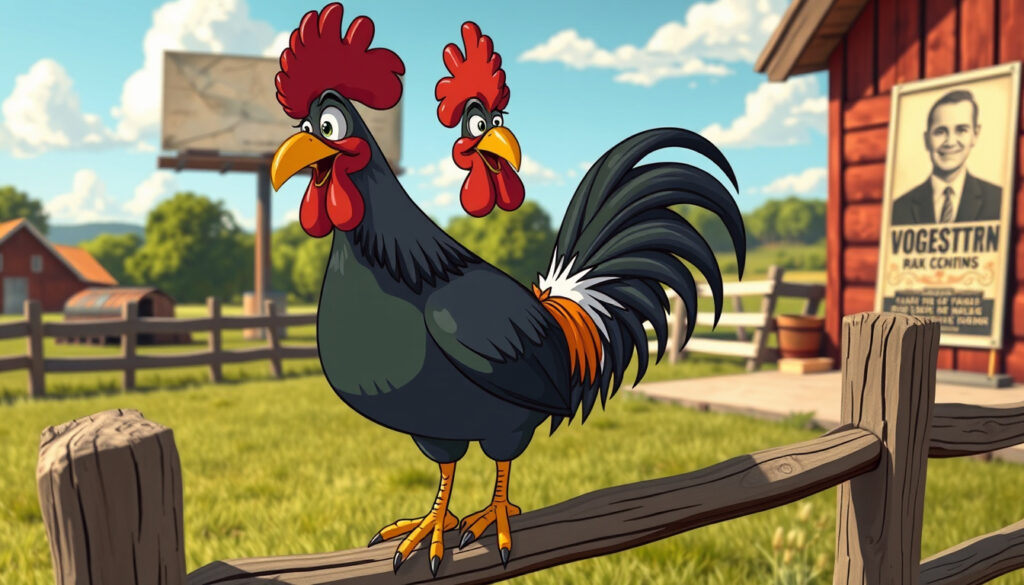
Foghorn Leghorn: The Rooster Rooted in 1940s Satire
The catchphrase “I say, I say, boy!” came from a 1940s radio character parodying Southern politicians. This article unpacks how Foghorn Leghorn’s persona was patched together from two separate radio comedians and what that says about the era.
First appearance: 1946 (Walky Talky Hawky) ·
Creator(s): Robert McKimson ·
Voice actor (original): Mel Blanc ·
Species: Anthropomorphic rooster ·
Notable catchphrase: “I say, I say, boy!” ·
Based on: Senator Claghorn (Fred Allen radio show)
Quick snapshot
- Debuted in 1946 (YourDictionary)
- Created by Robert McKimson (Cartoon Research)
- Voice by Mel Blanc (YourDictionary) (YourDictionary)
- “I say, I say, boy!” (YourDictionary)
- “That’s a joke, son” (Cartoon Research)
- “Pay attention to me!” (Fan site)
- Senator Claghorn from Fred Allen show (Cartoon Research)
- Caricature of a Southern orator (Cartoon Research)
- Miss Prissy (hen) (Fan site)
- Henery Hawk (chicken hawk) (YourDictionary)
- Barnyard Dawg (dog) (YourDictionary)
Six key facts, one pattern: the rooster was built from two radio influences—the hard-of-hearing Sheriff and the bombastic Senator Claghorn—stitched together by animator Robert McKimson.
| Label | Value |
|---|---|
| Full name | Foghorn Leghorn |
| Species | Rooster |
| First cartoon | Walky Talky Hawky (1946) |
| Last cartoon appearance (as lead) | The Foghorn Leghorn (1948) |
| Voice actor | Mel Blanc (1946–1989) |
| Catchphrase origin | Senator Claghorn |
What famous saying is Foghorn Leghorn?
His signature phrases
- “I say, I say, boy!” — the most recognizable opening, used across dozens of shorts (YourDictionary)
- “That’s a joke, son” — inherited directly from the radio character Senator Claghorn (Cartoon Research)
- “Don’t stand here with your beak open! Say something! Explain yourself!” — from the cartoon The Foghorn Leghorn (IMDb)
Foghorn’s catchphrases are not random; they are a direct transmission from 1940s radio comedy. The repetition of “I say” and the mocking “That’s a joke, son” were designed to telegraph a bloviating Southern politician to listeners who would have instantly recognized the type.
Context for “I say, boy”
The “I say” opening is a rhetorical tic meant to signal the character’s self-importance. According to Cartoon Research (animation history site), this phrasing came from Senator Claghorn’s habit of adding explanatory tags like “that is” and “I say” before every pronouncement. It gives the rooster a stalling, performative quality.
“I say, I say, boy! Pay attention to me!”
— Foghorn Leghorn, performed by Mel Blanc
The implication: what sounds like a silly cartoon expression is actually a deliberate satire of pompous Southern oratory from the golden age of radio.
What politician was Foghorn Leghorn based on?
Senator Claghorn
The character Senator Claghorn debuted in 1941 on the Fred Allen Show, a popular NBC radio program. Claghorn was a parody of a loud, long-winded Southern senator, created by comedian Kenny Delmar. According to Cartoon Research (animation history site), Foghorn Leghorn borrowed Claghorn’s catchphrases, his “I say” stammer, and his habit of calling everyone “boy.”
Fred Allen radio show
Fred Allen’s show was a comedy-variety program that thrived on political and regional caricature. The Claghorn character was so popular that Warner Bros. animators saw an obvious cartoon equivalent. As Cartoon Research notes, the two-radio-character synthesis—blending Claghorn with an earlier hard-of-hearing “Sheriff” character—became obvious in the 1948 cartoon The Foghorn Leghorn, where the rooster’s personality fully crystallized.
Foghorn Leghorn is not a pure invention; he is a mash-up of two radio comics that together created a cartoon archetype. Understanding the political satire behind him changes how you hear lines like “That’s a joke, son.”
The catch: the same caricature that made him a hit in the 1940s also encodes Southern stereotypes that can feel dated today—a trade-off that comes with any period piece of comedy.
Who was the female chicken on Foghorn Leghorn?
Miss Prissy
Miss Prissy is the only recurring hen character in Foghorn Leghorn’s world, often portrayed as the object of the rooster’s blundering romantic advances. According to a fan site documenting Foghorn Leghorn lore, she is a prim, nervous hen who frequently rejects or outwits him.
Role in the cartoons
- She appears in several shorts, often trying to get Foghorn to act more refined.
- She is sometimes paired with Henery Hawk as a comedic foil.
What this means: Miss Prissy provides the domestic counterweight to Foghorn’s bombast, reinforcing the classic conflict between a loud male and a sensible female.
Why did they call him Foghorn Leghorn?
Name origin
The name “Foghorn” refers to the character’s loud, booming voice—like a ship’s foghorn. “Leghorn” is a breed of chicken known for white feathers and active behavior. YourDictionary (language resource) confirms this dual meaning: the first part describes his volume, the second part his species.
Breed reference
The Leghorn chicken breed originates from Italy (port of Livorno, anglicized to “Leghorn”). Naming the rooster after that breed added a layer of comic specificity—a very precise chicken type for a very exaggerated character.
The pattern: Warner Bros. often gave characters punny names (Bugs Bunny, Daffy Duck). Foghorn Leghorn is a two-word joke: blast + breed.
Why does Foghorn Leghorn say “I say”?
Southern drawl
The “I say” repetition is a hallmark of a caricatured Southern accent—slow, repeated starts, as if the speaker is collecting his thoughts. This was a staple of radio comedy’s “Southern senator” archetype.
Influence of Senator Claghorn
As Cartoon Research (animation history site) documents, the line “I say” and its variants (“I say, I say”) were lifted directly from the Claghorn character. The rooster inherited the mannerism wholesale—including the habit of adding “boy” after every address.
The same accent that makes Foghorn instantly recognizable also reinforces a regional stereotype that modern audiences may find uncomfortable. Enjoying the comedy now means understanding the caricature’s roots.
“I say, boy! That’s a joke, son.”
— Foghorn Leghorn, as documented by Cartoon Research
The implication: the rooster’s speech pattern is a direct transcript of 1940s radio comedy. Every “I say” is a nod to the Senator Claghorn character that predated him.
What we know and what remains unclear
Confirmed facts
- Foghorn Leghorn first appeared in 1946 (YourDictionary)
- He was based on Senator Claghorn from the Fred Allen radio show (Cartoon Research)
- His catchphrase is “I say, I say” (YourDictionary)
- Miss Prissy is a character in his cartoons (Fan site)
What is unclear
- The exact number of Foghorn Leghorn cartoons is disputed; some obscure shorts exist that are hard to count (YourDictionary estimates 28).
- Whether Foghorn Leghorn will appear in future Warner Bros. productions is unknown as of 2025.
“The character of Foghorn Leghorn was a combination of two radio characters—the Sheriff and Senator Claghorn—and the blend became seamless in his first starring cartoon.”
— Robert McKimson, animator (via Cartoon Research)
For anyone studying American animation, the legacy of Foghorn Leghorn is a case study in how borrowed radio satire shaped cartoon archetypes. The rooster may seem like a silly character, but his creation reflects a deliberate commentary on political bombast and regional stereotyping that still resonates.
Related coverage: modern political satire like The Thick of It fördjupar bilden av The Thick Of It – Clever Political Satire Analysis.
Frequently asked questions
What does Foghorn Leghorn say?
His best-known lines include “I say, I say, boy!”, “That’s a joke, son”, and “Pay attention to me!”. These phrases are drawn from radio comedian Kenny Delmar’s Senator Claghorn character.
Is Foghorn Leghorn a rooster or a chicken?
He is a rooster—a male chicken. The “Leghorn” in his name refers to the Leghorn chicken breed.
What dog appears with Foghorn Leghorn?
The Barnyard Dawg is his frequent canine antagonist. He often schemes against Foghorn in barnyard settings.
How tall is Foghorn Leghorn?
His height varies between cartoons, but he is consistently depicted as taller than Henery Hawk and about the same size as Barnyard Dawg.
Which Looney Tunes character has a Southern accent?
Foghorn Leghorn is the primary Looney Tunes character known for his exaggerated Southern drawl, which was based on radio comedian Senator Claghorn.
What is the meaning of Foghorn Leghorn?
“Foghorn” symbolizes his loud voice, and “Leghorn” refers to the Italian chicken breed. Together the name is a pun that summarizes his appearance and personality.
Related reading
More related posts
 Pantoprazole 20 mg – Uses, Dosage and Side Effects
 Curried Sausages Recipe – Classic Australian Comfort Food
 Liam Baker: Trade, Suspension and Eagles Return
 Michael Rosenbaum: Why He Left Smallville for Podcasting
 12v Water Pump Buying Guide: Prices, Specs & Installation
 Christine McVie: Cause of Death, Stevie Nicks Tribute, Legacy
 Mia McKenna-Bruce: Age, Career, EastEnders Role, Facts
 Shark Tank: Richest Sharks, Top Products & Rejected Deals
