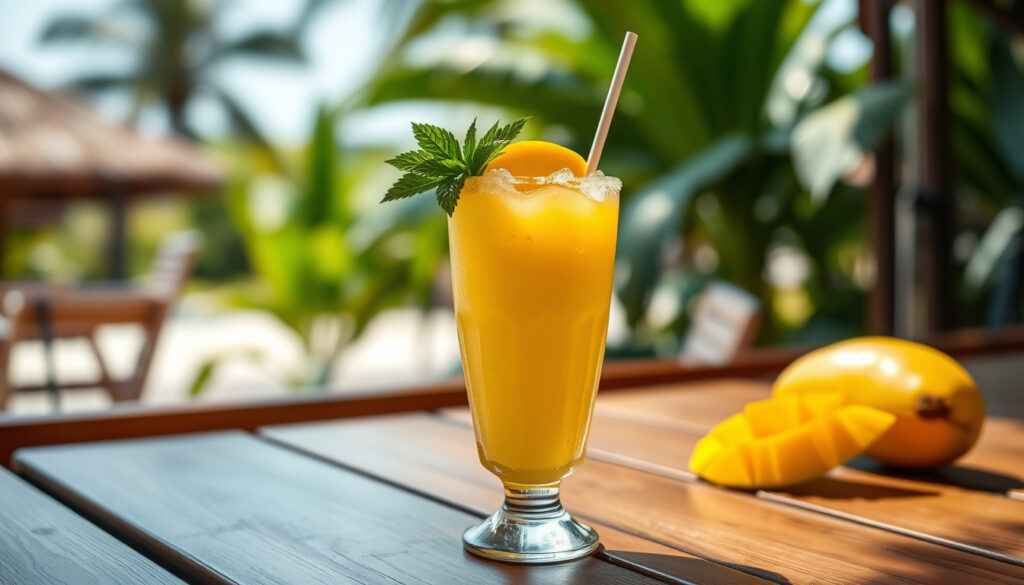
Mango Daiquiri Recipe: Perfect Frozen Cocktail Guide
There’s something about a mango daiquiri that feels like a cheat code for summer — sweet, tangy, and dangerously easy to drink. But getting the balance right depends on one often-overlooked detail: your mango’s ripeness.
Prep time: 5 minutes · Servings: 1 cocktail · Calories: ~250 kcal · Ingredients: 5–7 items · Alcohol content: ~15% ABV
Quick snapshot
- Mango daiquiri contains rum, lime, and mango (Savored Sips (cocktail blog))
- Frozen version is blended with ice (Pook’s Pantry (recipe site))
- White rum is the standard base spirit (RecipeTin Eats (cooking blog))
- Best mango variety for daiquiris
- Optimal sweetness level across different ripeness stages
- Exact alcohol content of slushie vs blended versions
- No fermentation time — ready in 5 minutes (Pook’s Pantry)
- Recommend serving immediately after blending (RecipeTin Eats) (Pook’s Pantry)
- Variations with vodka, gin, or no alcohol
- Garnish with mango slice or maraschino cherry
Six key attributes define every mango daiquiri — here’s how they stack up across the most common variations.
| Attribute | Typical value |
|---|---|
| Base spirit | White rum |
| Key fruit | Mango (fresh or frozen) |
| Acid | Lime or lemon juice |
| Sweetener | Simple syrup |
| Preparation method | Blended or shaken |
| Glass | Cocktail or hurricane glass |
What ingredients are in a mango daiquiri?
A classic mango daiquiri relies on just five core components: rum, mango, lime, sweetener, and ice. Savored Sips (cocktail blog) defines a daiquiri as a cocktail made with rum, lime juice, and sugar — the mango simply replaces part of the sweetener and adds body.
What type of rum is best?
- White rum is the standard choice because its clean, light flavor lets the mango shine (RecipeTin Eats (cooking blog)).
- Some recipes add orange liqueur like Cointreau: Julie’s Taste (home cooking blog) uses light rum with Cointreau and agave instead of simple syrup.
What sugar should I use?
- Simple syrup is the most common sweetener (equal parts sugar and water). Pook’s Pantry (recipe blog) instructs you to simmer sugar and water together first.
- Julie’s Taste swaps syrup for agave and water, a lighter alternative that affects the mouthfeel.
When you use an extremely ripe mango, you can reduce the simple syrup by up to one-third — but under-ripe mangoes require more sugar to avoid a sour, thin drink. The ripeness of your fruit dictates the entire balance.
The implication: Your choice of mango ripeness directly determines how much sweetener you need, making fruit selection the most critical step.
What alcohol is used in a mango daiquiri?
White rum dominates, but the category welcomes substitution. Here are the three most common bases.
Can you use vodka instead of rum?
- Yes. Vodka creates a milder, less characterful cocktail, but it still works. Master of Mixes (cocktail mix brand) sells a mango daiquiri mix that works with any spirit.
- Gin is another option — its botanical notes can clash with mango, so pair with extra lime (Jungle Pulp (puree producer) uses a shaken method with white rum only).
What alcohol goes into a frozen daiquiri?
- The same white rum. Pook’s Pantry calls for 1 cup of white rum per 4 cups of mango. RecipeTin Eats uses 3 oz of rum for one large mango.
- Frozen daiquiris often include orange liqueur (Cointreau or triple sec) to add depth (Emeril Lagasse (celebrity chef) uses 1/3 cup Cointreau for 2 mangoes).
What this means: Spirit substitution is possible, but expect a trade-off in character — the rum’s molasses notes are part of the classic daiquiri identity.
How to make the best frozen mango daiquiri?
The frozen version is by far the most popular — it turns the drink into a thick, icy treat. The key lies in ingredient order and blender technique.
How much ice should I use?
- Pook’s Pantry uses 2 cups of crushed ice for 4 cups of mango.
- RecipeTin Eats advises placing ice last in the blender because it blends better that way — 1 heaped cup of ice cubes for one mango.
Should I use fresh or frozen mango?
- Frozen mango yields a thicker, slushier texture because it replaces some of the ice volume (Julie’s Taste uses frozen mango cubes exclusively).
- Fresh mango gives a brighter flavor but requires more ice to freeze, which can dilute the taste. Pook’s Pantry uses fresh mango and adds crushed ice separately.
Using frozen mango lets you cut the ice by half, producing a creamier drink that stays flavorful. Fresh mango fans must compensate with extra sweetener to offset the dilution from more ice.
The pattern: Frozen mango simplifies the process by reducing ice volume, but fresh mango offers a more vibrant taste if you’re willing to adjust sweetness.
How to make mango daiquiri slushie?
A slushie is a frozen daiquiri with even more ice or frozen fruit, creating a semi-solid consistency that’s perfect for hot days.
How to make a mango daiquiri slushie with mango puree?
- Jungle Pulp (mango puree company) uses a cocktail shaker rather than a blender for its puree-based slushie, combining 2 oz white rum, 1 oz mango puree, 3/4 oz lime juice, and 1/2 oz simple syrup, then shaking with ice and straining over fresh ice.
- To make it slushie-style, use a blender and add more ice until the consistency is like a snow cone.
Can I make a slushie without alcohol?
- Yes — omit the rum and orange liqueur, and increase the mango and ice. Savored Sips (cocktail blog) offers a lighter version that uses mango juice (made by blending mango with water and sugar) as a base.
The catch: The alcohol content drops significantly with extra ice, so a slushie is less potent than a shaken version — plan accordingly.
Does a daiquiri get you drunk?
Understanding alcohol content helps you pace yourself. A standard daiquiri’s strength varies by preparation.
How much alcohol is in a daiquiri?
- A classic daiquiri with 1.5 oz of 80-proof rum contains about 0.6 oz of pure alcohol, giving it an ABV of roughly 25% before ice (RecipeTin Eats uses 3 oz rum, which would push ABV higher if not diluted).
- Frozen daiquiris have a lower effective ABV because the ice dilutes the alcohol during blending — roughly 10–15% ABV depending on ice volume.
- Individual metabolism, body weight, and drinking speed matter more than the recipe itself.
What factors affect intoxication?
- Food in the stomach slows absorption.
- A slushie drunk quickly over ice can be deceptive because the alcohol is less concentrated but the volume is larger.
The implication: Knowing the ABV helps you plan your evening; a frozen daiquiri’s lower alcohol concentration can lead to overconsumption if you don’t account for volume.
Step-by-step: Classic mango daiquiri (frozen)
This method produces a smooth, slushy drink that works for any mango daiquiri variation. Adjust the syrup based on your mango’s sweetness.
- Peel and chop a large ripe mango (about 1 cup of flesh).
- In a blender, add 3 oz white rum, 1/4 cup fresh lime juice, 2 tbsp simple syrup, the mango, and 1 heaped cup of ice cubes. Place ice last (RecipeTin Eats).
- Blend on high until smooth and slushy, about 20–30 seconds.
- Taste and add more syrup if the mango was under-ripe.
- Pour into a chilled cocktail glass. Rub the rim with a lime wedge and dip in sugar (Emeril Lagasse (celebrity chef)).
- Garnish with a mango slice or maraschino cherry.
What this means: Following the layering order — ice last — ensures even blending and avoids a watery result.
What we know and what’s still unclear
Confirmed facts
- Mango daiquiri contains rum, lime, and mango (Savored Sips)
- Frozen version is blended with ice (Pook’s Pantry)
- White rum is standard (RecipeTin Eats)
What’s unclear
- Best mango variety
- Optimal sweetness level
- Exact alcohol content of slushie vs blended
The pattern: The uncertainties revolve around personal preference and ingredient variability, meaning home cooks should expect to experiment.
Expert perspectives
“The key to a great mango daiquiri is using a ripe mango and adjusting the sugar syrup to match its sweetness. A perfect ratio is one part rum, one part lime, and two parts mango, then tweak the sweetener.”
— Nagie, Recipe Developer at RecipeTin Eats
“This frozen mango daiquiri is one of the easiest drink recipes you can make, with just six ingredients — fresh mangoes, lime, rum, sugar, water, and ice.”
— Staff Reviewer, Pook’s Pantry
The appeal of a mango daiquiri lies in its adaptability, but the trade-off is real: each variation demands a slightly different sugar balance. For anyone looking to make a crowd-pleasing cocktail at home, the choice is clear: start with a ripe mango, adjust the syrup to match its natural sweetness, and you’ll avoid a drink that’s either too tart or too cloying.
Related reading: Pook’s Pantry · RecipeTin Eats
For a fruity twist on the classic, try this frozen strawberry daiquiri recipe for a refreshing summer alternative.
Frequently asked questions
How can I make a mango daiquiri without a blender?
Shake the ingredients vigorously in a cocktail shaker with ice, then strain. This method using mango puree is demonstrated by Jungle Pulp.
Can I use canned mango puree?
Yes. Canned puree is a convenient substitute — just check the label for added sugar and adjust your syrup accordingly.
What is the difference between a daiquiri and a margarita?
Daiquiris are based on rum and lime; margaritas use tequila and orange liqueur. Both are sour-style cocktails.
How do I store leftover mango daiquiri?
Pour into an airtight container and freeze. The texture will be more icy after thawing, so re-blend briefly before serving.
What garnish is best for a mango daiquiri?
A fresh mango slice, a lime wheel, or a maraschino cherry. A sugared rim is recommended by Emeril Lagasse.
Is a mango daiquiri gluten-free?
Yes — all standard ingredients (rum, mango, lime, sugar) are naturally gluten-free. Verify your rum brand if you have celiac disease.
More related posts
 Wilmer Valderrama: Biography, Relationships, and Career Facts
 Time in Fiji – Current UTC+12 FJT No DST
 Chelsea Manning: Biography, Leaks, Prison, and Life After Release
 Art Garfunkel’s Health and Paul Simon Friendship Update
 Ocean Ramsey: Biography, Career, Net Worth, Shark Conservation
 Max King Injury: What Happened to St Kilda’s Star Forward
 Shadow Milk Cookie: Lore, Corruption, and FAQ Explained
 Iran News Today: Hormuz Ship Seizures & Trump Updates
