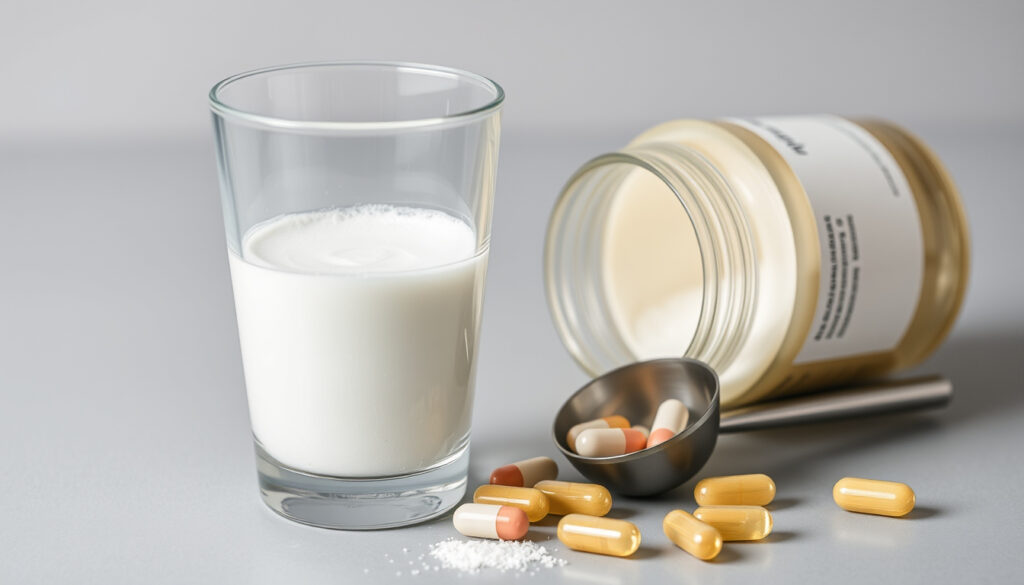
Collagen Protein Powder: Evidence on Benefits and Risks
You’ve seen the jars lining pharmacy shelves and the influencers swirling white powder into their morning coffee. Collagen protein powder has become one of the most popular supplement categories on the market, but separating the science from the sales pitch isn’t always straightforward.
Market growth (2022-2027): CAGR over 9% ·
Protein per serving: 18-20g ·
Active ingredient: Hydrolyzed collagen peptides (Type I, II, III) ·
Commonly cited benefits: Skin elasticity, joint health, hair growth ·
Price range (per 100g): $0.60 – $1.50
Quick snapshot
- Hydrolyzed collagen peptides are absorbed into the bloodstream (Rupa Health (functional medicine resource))
- Collagen is not a complete protein — it lacks adequate tryptophan (Bolt Pharmacy (UK pharmacy guide))
- Supplementation shows modest improvements in skin hydration and elasticity (Momentous (sports nutrition brand))
- Direct effect on belly fat reduction is not established (Bolt Pharmacy)
- Efficacy for Ehlers-Danlos syndrome is not clinically proven (Momentous)
- Long-term safety of daily doses above 20g is poorly studied (Transparent Labs)
- Skin changes typically appear after 4-8 weeks of daily use (Transparent Labs)
- Joint comfort improvements may take 8-12 weeks (Momentous)
- Increased regulatory scrutiny on supplement quality (FDA does not pre-approve) (Bolt Pharmacy)
- More head-to-head trials comparing collagen with whey for muscle recovery (Momentous)
- Expansion of plant-based collagen alternatives (still early stage) (Transparent Labs)
Four key specs define what you get in a typical collagen protein powder — and what you don’t.
| Label | Value |
|---|---|
| Primary active component | Hydrolyzed collagen peptides |
| Recommended daily dose (common) | 10-20 grams |
| Protein content per scoop | 9-18g (depends on brand) |
| Absorption rate | High (hydrolyzed form is easily absorbed) |
| Typical cost per month | $25-$60 |
Is collagen protein powder really good for you?
What the science says about collagen supplementation
Women taking 2.5g of collagen peptides daily for 8 weeks showed a statistically significant increase in skin hydration and a reduction in wrinkle depth compared with placebo, according to Proksch et al. (2014).
The most cited study on collagen for skin comes from Proksch et al. (2014), published in Skin Pharmacology and Physiology. That trial found that women taking 2.5g of collagen peptides daily for 8 weeks showed a statistically significant increase in skin hydration and a reduction in wrinkle depth compared with placebo. The effect was modest — about a 12% improvement in hydration — but real.
For joint pain, a 2008 study by Clark et al. in the International Journal of Sports Medicine reported that athletes taking 10g of hydrolyzed collagen daily experienced less activity-related joint pain over 24 weeks. Both studies have been replicated with similar results, though the effect size is smaller than what you’d expect from NSAIDs or physical therapy.
Collagen supplements show benefit for specific outcomes — skin and joints — but the improvements are moderate and take weeks to appear. If you expect a dramatic transformation, the data doesn’t support it.
Who may benefit most from collagen protein powder
- Adults over 40 experiencing natural declines in collagen production (Rupa Health)
- Athletes looking to support joint recovery alongside a complete protein source
- People with low dietary protein who need a convenient powder — but should not rely on collagen alone
The pattern: collagen works best as a complement, not a substitute. For muscle protein synthesis you still need a complete protein like whey, soy, or egg.
Collagen protein powder benefits: Should I take a supplement?
Potential benefits for skin, joints, and bones
Beyond the studies above, the broader evidence — summarised by MD Anderson Cancer Center (oncology institution) — suggests that for healthy adults, collagen supplements are low-risk and may offer supportive benefits when used alongside a balanced diet. Some research indicates improvements in bone mineral density post-menopause, though the data is still emerging.
“Collagen is not a complete protein — it lacks adequate tryptophan.” — Bolt Pharmacy (UK pharmacy guide)
Considerations before starting a collagen supplement
- Not recommended during pregnancy or breastfeeding without medical advice
- Always check the source: some marine collagen is derived from fish and can trigger allergies
- Collagen lacks tryptophan, meaning it does not support serotonin production the way other proteins do (Rupa Health)
The trade-off: you get targeted amino acids for connective tissue but miss the broad metabolic signals that complete proteins provide.
What are the 5 signs that collagen is working?
Visible changes in skin texture and firmness
Within 4-8 weeks, users often report that skin feels less dry and looks slightly plumper. One measurable marker: a decrease in transepidermal water loss, which the Proksch study tracked. It’s subtle — not a facelift in a jar.
Improvement in joint comfort and mobility
After 8-12 weeks, some athletes notice they feel less stiff after morning runs or heavy lifting sessions. These are subjective reports but consistent across multiple trials (Momentous). Avoid expecting faster hair or nail growth — the evidence there is thinner.
Why this matters: The signs are real but incremental. If you’re not looking for them, you might miss them. Collagen isn’t a quick fix; it’s a long-game supplement.
Most users who stick with collagen for 8+ weeks notice a “something changed” feeling rather than a dramatic before-and-after. That’s consistent with the science: effects are real but moderate.
The implication: collagen is a long-game supplement for those who value incremental improvements.
What is the downside of taking collagen every day?
Potential side effects and digestive issues
Some people experience mild gastrointestinal discomfort, a feeling of fullness, or bloating — especially when taking more than 20g per day. These are usually temporary and resolve with dose adjustment. More serious risks include allergic reactions to fish or shellfish sources.
Cost and quality variability in the supplement market
Collagen powders range from $0.60 to $1.50 per 100g, but price doesn’t guarantee purity. Because the FDA does not pre-approve dietary supplements, quality varies widely. A Transparent Labs analysis notes that heavy metal contamination has been found in some low-cost products, especially those sourced from non-certified facilities.
For anyone with kidney disease or those taking medications, a clinician should be consulted before starting (MD Anderson).
The pattern: The downside isn’t that collagen is dangerous — it’s that the market is uneven, and the cost adds up. For some, the mild benefits may not justify the monthly spend.
Collagen protein powder vs whey protein: which is better?
Amino acid profile comparison
Whey is a complete protein with all nine essential amino acids, including high leucine — the primary trigger for muscle protein synthesis. Collagen is rich in glycine, proline, and hydroxyproline, but it lacks sufficient tryptophan and has minimal leucine. The practical consequence: whey builds muscle; collagen builds connective tissue.
Six differences, one pattern: each has a distinct job.
| Feature | Collagen Protein | Whey Protein |
|---|---|---|
| Complete protein? | No (lacks tryptophan) | Yes |
| Leucine content | Low | High |
| Best for | Skin, joints, connective tissue | Muscle recovery, growth |
| Typical serving protein | 9-12g | 20-25g |
| Suitable for vegans | No (animal-derived) | No (milk-derived) |
| Reported side effects | Mild GI upset | Bloating (lactose-sensitive) |
Best use cases: recovery, skin health, and muscle building
If your goal is post-workout muscle repair, whey is the clear winner (Bolt Pharmacy). For skin elasticity or joint comfort, collagen has the edge. Many athletes use both: whey after training, collagen in the morning for connective tissue support.
The trade-off: Collagen is not a substitute for whey. If you replace whey with collagen, you’ll lose muscle-building capacity. The smart play is to use collagen as an addition, not a replacement.
Can collagen supplements interact with medications?
Collagen itself has few known drug interactions, but the supplemental form may contain additives (e.g., vitamin C, biotin) that could interact with certain prescriptions. More importantly, people with chronic kidney disease should avoid high-protein supplements without medical supervision (Rupa Health). If you take blood thinners or have a history of oxalate kidney stones, consult your doctor before starting collagen.
What to watch: Always read the full ingredient panel. Some marine collagen powders contain high levels of calcium that could affect cardiac medications.
Upsides
- Modest improvements in skin hydration and elasticity (supported by clinical trials)
- May reduce joint pain and improve mobility in active adults
- Convenient powder form, easily mixed into hot or cold liquids
- Low risk of side effects at typical doses (10-20g/day)
- Rich in glycine and proline, amino acids often underrepresented in modern diets
Downsides
- Not a complete protein — cannot build muscle on its own
- Effects are modest and take 4-12 weeks to appear
- Cost: $25-60 per month for a routine dose
- Quality varies widely; heavy metal risk in cheap products
- Unsuitable for vegetarians and vegans (animal-derived)
op2labs.com, levelsprotein.com, pmc.ncbi.nlm.nih.gov, youtube.com
For those evaluating whether to incorporate this supplement into their routine, a closer look at the evidence for collagen powder offers complementary research on its effectiveness.
Frequently asked questions
Can collagen protein powder cause weight gain?
Not directly — it contains about 35 calories per scoop. Weight gain only occurs if total daily calories exceed expenditure. Some users report a feeling of fullness, which may actually help with weight management.
How long does it take for collagen supplements to show results?
Skin changes are typically noticed after 4-8 weeks of daily use. Joint improvements may take 8-12 weeks. Hair and nail results are less consistent and may require 3-6 months if they occur.
Is collagen protein powder safe for people with kidney disease?
Anyone with reduced kidney function should consult a nephrologist before taking any protein supplement, including collagen. High protein intake can strain damaged kidneys.
Can you take collagen powder if you are allergic to fish?
Check the label carefully. Marine collagen is made from fish skin or scales. Bovine and porcine collagen are animal-derived but not from fish — they are generally safe for fish allergies, but always confirm with the manufacturer.
Does collagen powder expire or lose effectiveness over time?
Yes. Most collagen powders have a 1-2 year shelf life. Exposure to heat, light, or moisture can degrade the peptides. Store in a cool, dry place and use before the expiration date.
Is there a difference between collagen peptides and collagen protein powder?
No — the terms are often used interchangeably. “Collagen peptides” refers to the hydrolyzed form that dissolves easily. “Collagen protein powder” typically contains the same peptides, sometimes with added flavorings or sweeteners.
Can collagen help with hair growth or thickness?
The evidence is weaker than for skin and joints. Some small studies suggest a benefit, but the data is not robust enough to make a strong recommendation. If hair growth is your primary goal, focus on iron, biotin, and overall protein intake first.
Adults interested in skin hydration or joint comfort should consider a 3-month trial of collagen, while those seeking muscle growth should choose whey. The evidence supports using collagen as an addition to a diet that already includes complete proteins, not as a replacement.
More related posts
 Chris Briney: Biography, Age, Career, and Relationships
 Ocean Ramsey: Biography, Career, Net Worth, Shark Conservation
 Leo Sayer 2025: Illness, Tour, Net Worth & Family Facts
 Liam Baker: Trade, Suspension and Eagles Return
 Hannah Owo: Age, Ethnicity, Net Worth, and Content Career
 Molly Little: Biography, Net Worth, and Career Facts
 Usman Khawaja Retirement: Net Worth, Wife Rachel & Children
