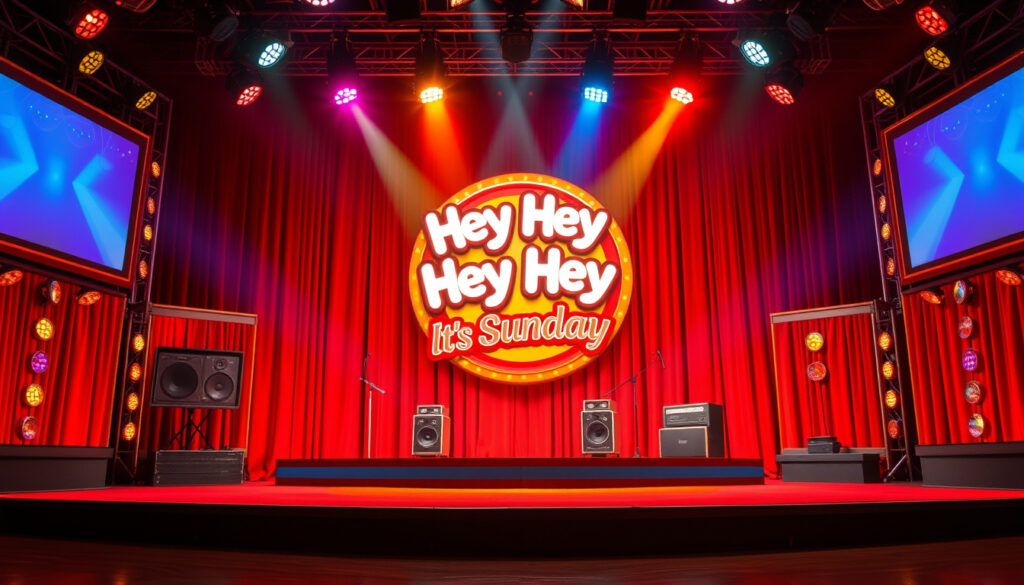
Hey Hey It’s Saturday: History, Hosts & What Happened
If you grew up in Australia between the 1970s and 1990s, Saturday night meant one thing: Hey Hey It’s Saturday. What started as a modest children’s program morphed into one of the most beloved variety shows the country has ever produced, running for an extraordinary on the Nine Network.
Original run: 1971–1999 · Revivals: 2009–2010, 2022 · Network: Nine Network · Main host: Daryl Somers · Total years: 28
Quick snapshot
- The show ran for 28 consecutive years on Nine Network (Wikipedia)
- Daryl Somers was the host from premiere to finale, 1971–1999 (Wikipedia)
- Ernie Carroll voiced and operated the beloved puppet Ossie Ostrich throughout the run (Museum of Broadcast Communications)
- The exact reason Nine Network chose to end the show in 1999 remains undocumented
- No public record details the financial or production budget at any point during the run
- Full list of awards won by the program has never been officially compiled
- : Show premieres as Saturday morning children’s block
- : Brief recess—only 40 episodes aired
- : Skyhooks world-first live interactive performance
- : Final episode airs as four-hour special
- Brief 25th-anniversary reunions reportedly aired in 2009–2010
- Specials reportedly returned in 2022 per IMDb records
- heyhey.tv serves as the unofficial archive for clips and memories
Six key data points define this show’s identity and legacy—genre, origin, network affiliation, episode span, and official digital home.
| Field | Value |
|---|---|
| Genre | Variety show |
| Country | Australia |
| Original network | Nine Network |
| No. of seasons | Multiple over 28 years |
| Official site | heyhey.tv |
What happened to Hey Hey, it’s Saturday?
The show ended its original run on , airing as a four-hour farewell special from 6:30pm to 10:30pm (Wikipedia). By that point, the program had outlasted almost every competitive challenge from rival networks—a remarkable feat for any live television production. The Museum of Broadcast Communications notes that the show showed signs of tiredness and repetition in its final years, particularly after losing key characters like Ossie Ostrich. No official cancellation announcement ever detailed the specific reasons Nine Network chose to end production.
End of original run
The final regular episode has been cited as 13 November 1999, with the 20 November special serving as the public farewell broadcast. The show had occupied Saturday night prime time since 1985, consistently ranking among Nine’s highest-rated programming. By 1999, however, industry observers noted the format had become repetitive, and the changing television landscape made sustained live variety programming increasingly difficult to justify against cheaper reality and quiz alternatives.
Revival attempts
Twenty-five years after the premiere, the show returned for anniversary specials. The 2009–2010 reunion saw Rove McManus joining Daryl Somers for limited episodes, bringing a younger generation of viewers into the nostalgic fold. Additional specials reportedly aired in 2022, though details remain sparse in public records. These revivals confirmed enduring audience affection but never achieved the original run’s consistency or duration.
Current status
No active production exists. heyhey.tv continues to serve as the official archive for clips and historical material, allowing fans to revisit iconic moments. The show exists primarily in memory and through sporadic broadcast of classic episodes on regional networks and streaming platforms.
The pattern across three decades shows how live variety programming eventually gave way to cheaper formats across all Australian networks.
Who was the first host of Hey Hey It’s Saturday?
Daryl Somers anchored the program from the very first episode on , hosting continuously until the final broadcast in (Wikipedia). The Museum of Broadcast Communications describes him as a comedian who became perhaps the successor to Graham Kennedy in Australian television comedy—high praise given Kennedy’s iconic status as “the King of Australian television.” Somers later assumed the role of executive producer, overseeing both creative and business aspects of the program.
Daryl Somers era
The show premiered as a Saturday morning children’s program, airing from 8:30am to 11:30am with cartoons and comedic segments featuring Somers and the newly introduced Ossie Ostrich puppet. Ernie Carroll provided the voice and arm movements for Ossie, a character who would become synonymous with the show’s identity. The show briefly went into recess in 1978, airing only 40 episodes between September and November that year, before returning with renewed format in 1979.
Other hosts
Jacki MacDonald joined as co-host when the show returned in February 1979, bringing additional warmth and wit to the proceedings. Red Symons came aboard in October 1984 following a landmark world-first live interactive performance by the Skyhooks band, where Daryl and Ossie appeared on a giant screen while the band performed from a concert venue. Livinia Nixon also served as co-host during later years. During the brief 1984–1985 experiment as Hey Hey It’s Saturday Night in a 9:30pm timeslot, the show tested a more adult-oriented format.
Hosting transitions
The only significant hosting transition occurred during the 2009–2010 reunion specials, when Rove McManus stepped in alongside Somers. No other host ever held the main chair during the original run, making Daryl Somers one of Australian television’s most enduring presences—anchoring a live variety show for nearly three decades without interruption.
The implication for Australian television history is that Somers’ longevity set a benchmark for presenter commitment that no subsequent variety program has matched.
What happened to Jackie from Hey Hey It’s Saturday?
Jacki MacDonald established herself as the show’s primary female presence, joining as co-host when the program returned from its 1978 recess on (Wikipedia). Her partnership with Daryl Somers brought warmth and spontaneous comedy that helped transform the show from children’s entertainment into family viewing. MacDonald continued working in television after the original run concluded, remaining active in the Australian media landscape.
Jacki MacDonald’s role
Beyond co-hosting duties, MacDonald served as a judge on the beloved Red Faces segment—a talent competition that showcased amateur performers and became one of the show’s most memorable recurring features. Her natural rapport with Somers and her quick wit made her a fixture viewers looked forward to each week. The ad-libbing style encouraged by the production, combined with John Blackman’s double-entendre laden voice-over announcing, gave the show its distinctive edgy-but-family-friendly character.
Post-show career
After Hey Hey It’s Saturday ended, MacDonald continued appearing on television programs and maintained her presence in the entertainment industry. She has participated in reunion specials and remains a recognisable figure from Australian television’s golden era of live variety programming. Her continued relevance decades after the show’s conclusion speaks to the lasting impression she made on audiences during her tenure.
Current whereabouts
Public records do not document MacDonald’s current activities in detail, though she has appeared at industry events and television reunions when opportunities arise. The show’s enduring nostalgia culture keeps former cast members connected to their fan base through social appearances and occasional media commentary.
What this means for female presenters in Australian variety television is that her model of warm, quick-witted co-hosting set an enduring standard.
Who was the lady on Hey Hey It’s Saturday?
The show featured several notable female personalities throughout its run, with Jacki MacDonald standing out as the most prominent lady associated with the program. However, the format also showcased numerous female performers, contestants, and guests across various segments.
Key female cast
Beyond MacDonald, Livinia Nixon served as co-host during later years, bringing a different energy while maintaining the established format’s warmth. Various other women appeared as regular contributors, panelists, and performers throughout different eras. The show also regularly featured female contestants on Red Faces, providing a platform for amateur talent that wasn’t limited by gender.
Guest appearances
Celebrity guests included female performers from across the entertainment spectrum—from local Australian talent to international stars appearing via the show’s live-to-tape arrangements for overseas visitors. The variety format meant virtually any female entertainer could appear, whether for musical performances, comedy segments, or celebrity interviews.
Iconic characters
Ossie Ostrich, operated by Ernie Carroll, remained the show’s most recognisable character throughout its entire run. While the puppet itself was genderless, the human cast around it provided the gendered dynamic viewers associated with Saturday night entertainment. The chemistry between Somers, MacDonald, and Blackman’s off-beat announcing created an ensemble dynamic where individual personalities blended into a cohesive entertainment experience.
The catch is that without comprehensive archival footage, much of this female contribution remains undocumented in official records.
Why did Hey Hey It’s Saturday finish?
The official reason for the show’s conclusion has never been publicly articulated by Nine Network. Industry observers and broadcast historians identify several contributing factors, though none have been confirmed as the primary cause of cancellation.
Ratings decline
While the show remained a consistent performer throughout most of its run, the television landscape evolved significantly by the late 1990s. Reality programming, quiz shows, and cheaper-to-produce formats began dominating prime-time schedules across all networks. The Museum of Broadcast Communications notes that by 1999, the show “showed signs of tiredness, becoming repetitive after losing key characters like Ossie Ostrich.”
Network decisions
Nine Network’s programming strategy shifted during the late 1990s, prioritising formats with lower production costs and simpler production requirements. Live variety programming demands significant resources—multiple cameras, live performers, technical crews, and unpredictable content—compared to pre-recorded alternatives. The economics increasingly favoured alternatives that delivered reliable audiences with less investment.
Host factors
Daryl Somers had been with the show for nearly three decades by its conclusion. While his continued presence provided continuity, it also meant the program was deeply associated with a single personality in an era when networks increasingly sought fresh approaches. The departure of key creative contributors over the years may have contributed to the format’s eventual fatigue.
The implication for broadcasters is that live variety requires sustained creative investment that modern economics rarely justify.
Timeline of Hey Hey It’s Saturday
Eight distinct periods mark the show’s evolution from children’s programming to cultural institution.
| Date/Period | Event |
|---|---|
| Premiere on Nine Network as Saturday morning children’s block | |
| Brief recess—only 40 episodes aired between September and November | |
| Returns with Jacki MacDonald recruited as co-host | |
| Dr Hook appears in Episode 1 of the year, interacting with Daryl and Ossie | |
| Skyhooks perform world-first live interactive concert with Daryl on giant screen | |
| Brief experiment as Hey Hey It’s Saturday Night in 9:30pm timeslot | |
| Moves to Saturday nights 6:30pm–8:30pm, becomes consistent ratings winner | |
| Begins screening in New Zealand on TVNZ Channel 2 | |
| Final regular episode airs | |
| Four-hour farewell special airs from 6:30pm to 10:30pm |
Confirmed facts vs. rumors
The historical record establishes certain details with confidence while leaving others uncertain.
Confirmed facts
- 28-year run on Nine Network (1971–1999)
- Daryl Somers hosted from premiere to finale
- Ernie Carroll performed Ossie Ostrich throughout
- Jacki MacDonald joined as co-host in 1979
- heyhey.tv serves as official clip archive
What’s unclear
- Exact reason Nine chose to cancel the show
- Full list of awards the program won
- Whether future revivals are planned
- Complete financial or production budget details
- Exact number of episodes produced beyond “over 800”
What people said
Television variety such as Hey Hey emerges from Australia’s robust history of music hall, vaudeville, and revue on the stage and in radio.
— Museum of Broadcast Communications, Encyclopedia entry
What this reveals is how deeply Australian cultural identity was woven into the program’s format choices and audience expectations.
Despite its cultural significance, no comprehensive official archive or streaming platform exists for full episodes. Fans rely on heyhey.tv for clips and occasional regional broadcasts rather than systematic access to the show’s complete history.
Summary
Hey Hey It’s Saturday earned its place in Australian television history as the nation’s longest-running variety program, anchoring Saturday nights for generations of families across four transformative decades. Daryl Somers and his ensemble cast—from Ernie Carroll’s Ossie Ostrich to Jacki MacDonald’s sharp wit—created a entertainment experience that balanced comedy, music, and spontaneous moments in ways that felt genuinely live rather than scripted. The show’s end reflected industrial rather than creative failure: as Australian television shifted toward cheaper formats, live variety simply became harder to justify on balance sheets. For fans who grew up with the program, its conclusion marked the end of an era when television could be simultaneously silly, smart, and entirely unpredictable. The brief reunions since 1999 confirm that appetite for this kind of entertainment remains strong—but revival attempts have remained commemorations rather than sustained returns, leaving Hey Hey It’s Saturday firmly positioned as a beloved historical artefact rather than an ongoing concern.
The consequence for Australian broadcasting is that a generation’s shared cultural touchstone now exists only in memory and scattered archives, unavailable to new audiences seeking that particular blend of spontaneity and warmth. Fans of Australian drama series like Cast of McLeod’s Daughters may appreciate the same era of production that produced Hey Hey It’s Saturday, while those interested in international comparisons can explore how global fantasy productions handle the challenge of maintaining audience connection across decades.
en.wikipedia.org, en.wikipedia.org, history.sa.gov.au, youtube.com, awm.gov.au, youtube.com, nma.gov.au, forums.mediaspy.org, nma.gov.au
Frequently asked questions
What was Hey Hey It’s Saturday?
Hey Hey It’s Saturday was an Australian variety television program that aired on the Nine Network from 1971 to 1999. It began as a Saturday morning children’s show featuring cartoons and evolved into a prime-time variety program featuring live performances, comedy sketches, celebrity guests, and the iconic Red Faces talent segment.
Who hosted Hey Hey It’s Saturday?
Daryl Somers was the primary host throughout the show’s entire 28-year run from 1971 to 1999. Jacki MacDonald joined as co-host in 1979, and Livinia Nixon co-hosted during later years. Rove McManus appeared alongside Somers during the 2009–2010 reunion specials.
When did Hey Hey It’s Saturday end?
The final regular episode aired on 13 November 1999, with a four-hour farewell special broadcast on 20 November 1999. The show ran for 28 years total on the Nine Network.
What made Hey Hey It’s Saturday popular?
The show combined live comedy, music performances, and celebrity interviews with a distinctive ad-libbing style. John Blackman’s double-entendre announcing, Ernie Carroll’s Ossie Ostrich puppet, and Daryl Somers’ chemistry with co-hosts created unpredictable entertainment that appealed across generations. The Red Faces segment showcased amateur talent that resonated with family audiences.
Was there a Hey Hey It’s Saturday reunion?
Yes, the show returned for 25th-anniversary specials in 2009–2010, with Rove McManus joining Daryl Somers for limited episodes. Additional specials reportedly aired in 2022, though these were brief commemorations rather than sustained revivals.
Where can I watch Hey Hey It’s Saturday?
The official site heyhey.tv archives clips and historical material. Classic episodes occasionally air on regional networks and may be available through streaming platforms, though no comprehensive official archive exists for full episodes.
What are famous segments from Hey Hey It’s Saturday?
The most iconic segment was Red Faces, a talent competition featuring amateur performers. Other memorable features included Ossie Ostrich appearances, Trivial Pursuit with inventors, celebrity interviews, live musical performances, and comedy sketches. The show’s ad-libbing style and spontaneous moments became its signature characteristics.
More related posts
 Mount Kilimanjaro: Difficulty, Safety & Beginner Guide
 Mark Carney: From Central Banker to Canada’s Prime Minister
 40 Pounds in KG – Exact 18.14 kg Conversion Guide
 Crash Bandicoot: Species, Autism Talk, Games & Kid Suitability
 Gregory Peck: Biography, Cause of Death, Family and Legacy
 Ash Kash: Who She Is, Real Name, and Social Media Stats
 Grace Hayden: Biography, Career & Personal Life
 Instant Hot Water Dispenser vs Kettle: Pros, Cons & Costs (2026)
